How We Improved Our On-Page SEO: A Rank Math Case Study
A real on-page SEO experiment: We improved an existing WordPress article, yet its Rank Math score fell. See how a focus-keyword change raised it from 81 to 87 without changing the page.
On this page
A real WordPress on-page SEO experiment with practical improvements and a surprising Rank Math score test.
We wanted to improve the on-page SEO of an existing WordPress article. Rather than chase points in an SEO plugin, we examined what the article explained, what its readers searched for, and how easily they could find answers. We then improved the content, search-result description, headings, internal links and navigation. Finally, we checked the changes using Rank Math.
The score had fallen from 82 to 81.
Later, we changed two focus-keyword entries without rewriting a single sentence. Rank Math’s score jumped to 87. That small experiment became the most revealing part of our test. For advice on interpreting scores and prioritizing warnings beyond this experiment, see our Rank Math SEO score explanation and improvement guide.
That is the question behind this Rank Math case study: how should you improve an article for readers and search engines without treating a plugin score as the final goal? We’ll show the exact improvements, the surprising score experiment, and a repeatable planning method for your own articles.
If you are new to SEO, on-page SEO means improving an individual web page so readers can use it and search engines can understand its subject. For example, WordPress on-page SEO can involve rewriting an unclear introduction, using descriptive headings, correcting the page title and meta description, adding helpful images, and linking to related articles on your site. The meta description is the summary you write for search results, although Google sometimes displays a different excerpt.
Off-page SEO focuses on signals beyond your website, such as links from other websites; technical SEO covers site-wide issues such as crawling and site speed. Our published What Is SEO? guide explains these distinctions. For a practical walkthrough of improving an individual page, see our on-page SEO guide.
1. The purpose: Better content, not a perfect Rank Math score
Rank Math is a WordPress SEO plugin (sometimes written as “RankMath” in searches). When you edit a post, it checks selected aspects of the page and displays an SEO score out of 100 along with recommendations. Its Rank Math SEO checklist can remind you about headings, metadata and keyword placement. But a higher score does not automatically mean a more accurate article, a clearer explanation or better rankings. We therefore treated the checklist as a diagnostic aid rather than the judge of our content.
Our on-page SEO optimization had two linked goals. First, make the answer accurate, complete and easy to follow. Second, make the page easier for search engines to interpret using descriptive headings, metadata, relevant wording and links. We used Rank Math recommendations where they served these goals. We documented the before-and-after changes and kept Google Search performance as a separate measure. We did not set out to manufacture a score of 100.
We ran the experiment on Testonomics, an established website that teaches economics. The page explained the difference between microeconomics and macroeconomics. Because we could assess both the subject matter and the readability, this was a more useful test than optimizing a page merely because Rank Math marked it poorly. Here on Toolquo, we are reporting the method and evidence so WordPress beginners can apply the reasoning to a different subject.
2. Why this article, rather than a lower-scoring page?
We wanted a real article that already had search visibility but still offered editorial room for improvement. We also preferred not to make extensive experimental edits to a page that was already performing strongly in search. This meant looking beyond a low plugin score: a weak opening, avoidable metadata errors and incomplete explanations mattered more to our decision.
We selected “Microeconomics vs. Macroeconomics: Key Differences & Examples” because it was evergreen, its existing traffic was modest, and its structure and explanations offered room for improvement. The original URL was already visible in Google, so we kept it unchanged.
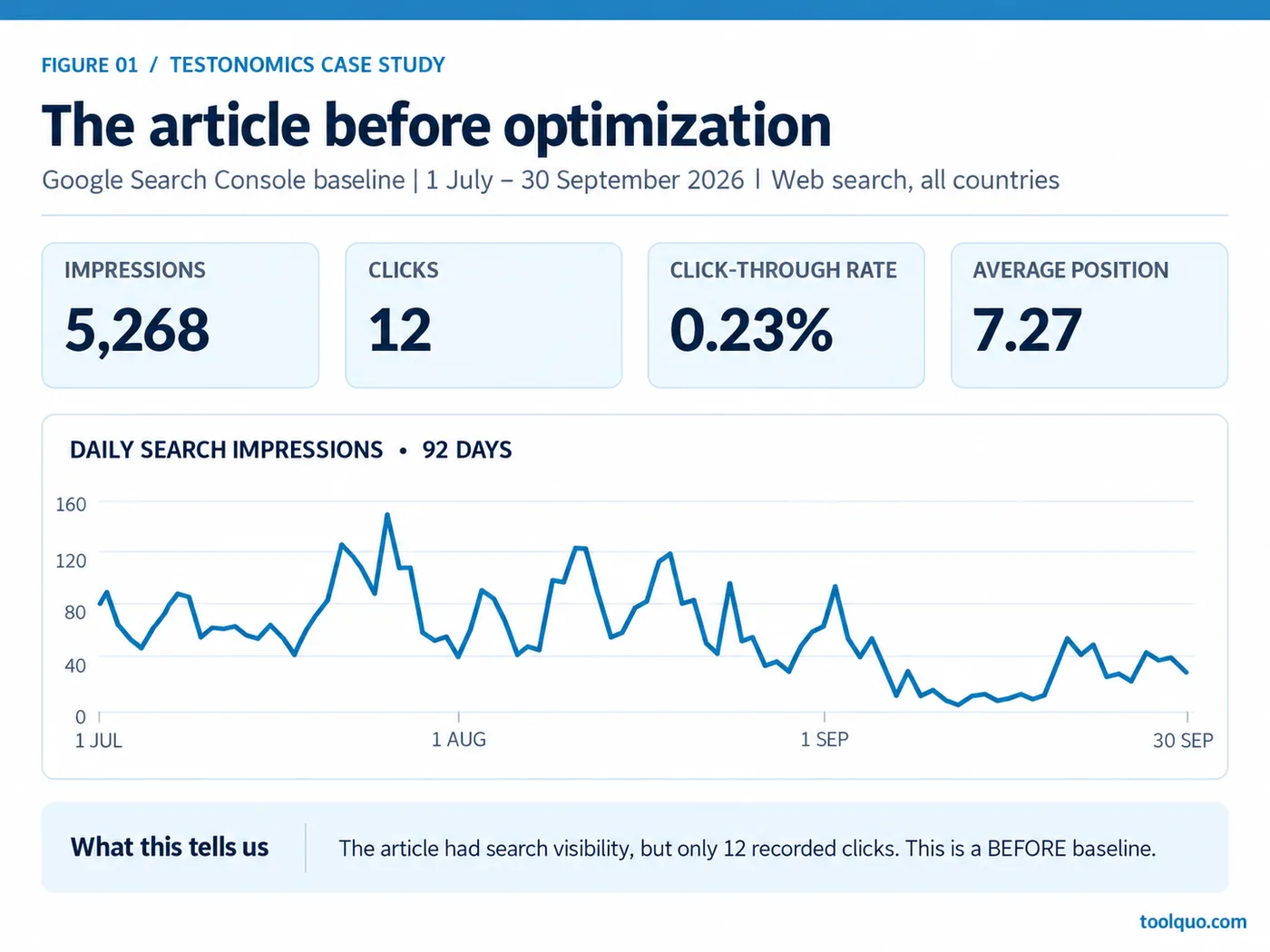
Before editing, we recorded how the selected page had performed in Google Search. Google Search Console is Google’s free reporting tool for tracking how your pages appear in and receive visits from Google results. An impression means the page was shown in a search result; a click means a searcher selected it. CTR is clicks divided by impressions. Average position summarizes where the page appeared across those searches, so it is not a fixed ranking for one keyword.
The page’s historical Google Search Console baseline was:
| Metric | July–September 2026 |
|---|---|
| Impressions | 5,268 |
| Clicks | 12 |
| Click-through rate | 0.23% |
| Average position | 7.27 |
Date range: July 1 to September 30, 2026. Search type: Web. Countries: All. Page filter: the exact original Testonomics article URL.
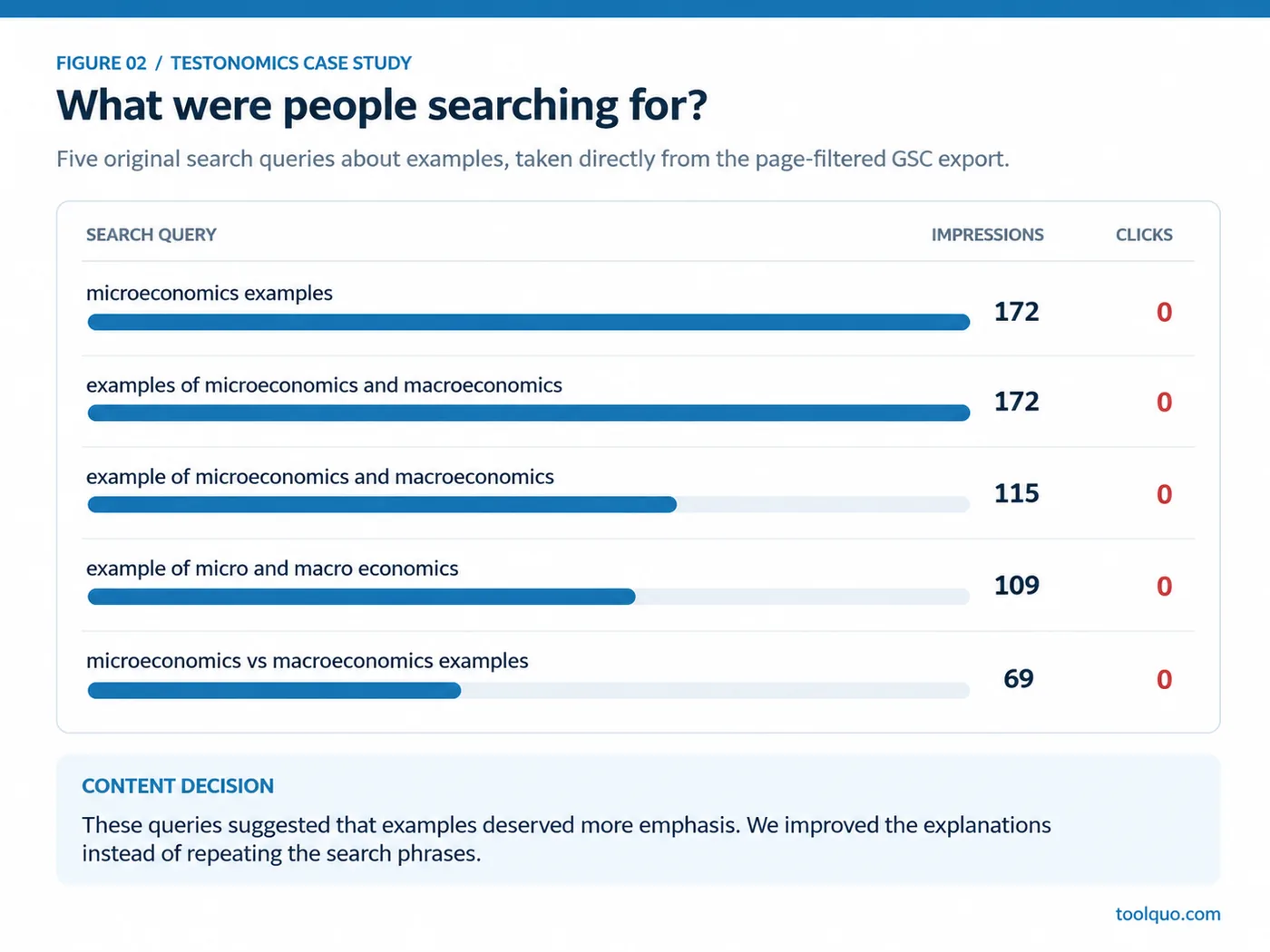
More revealing than the overall totals were the searches. The page appeared for queries such as “microeconomics examples,” “examples of microeconomics and macroeconomics,” and “microeconomics vs macroeconomics examples.” Some had impressions but no clicks in our exported query data.
Those queries suggested a practical test of the page’s usefulness: could a beginner quickly find clear examples, see why each example belonged to microeconomics or macroeconomics, and understand cases where both perspectives matter? We could not infer from impressions alone that a particular rewrite would increase clicks. Search Console showed us what to investigate; our subject knowledge and judgment determined how to respond.
3. Starting point: Rank Math SEO Score 82/100
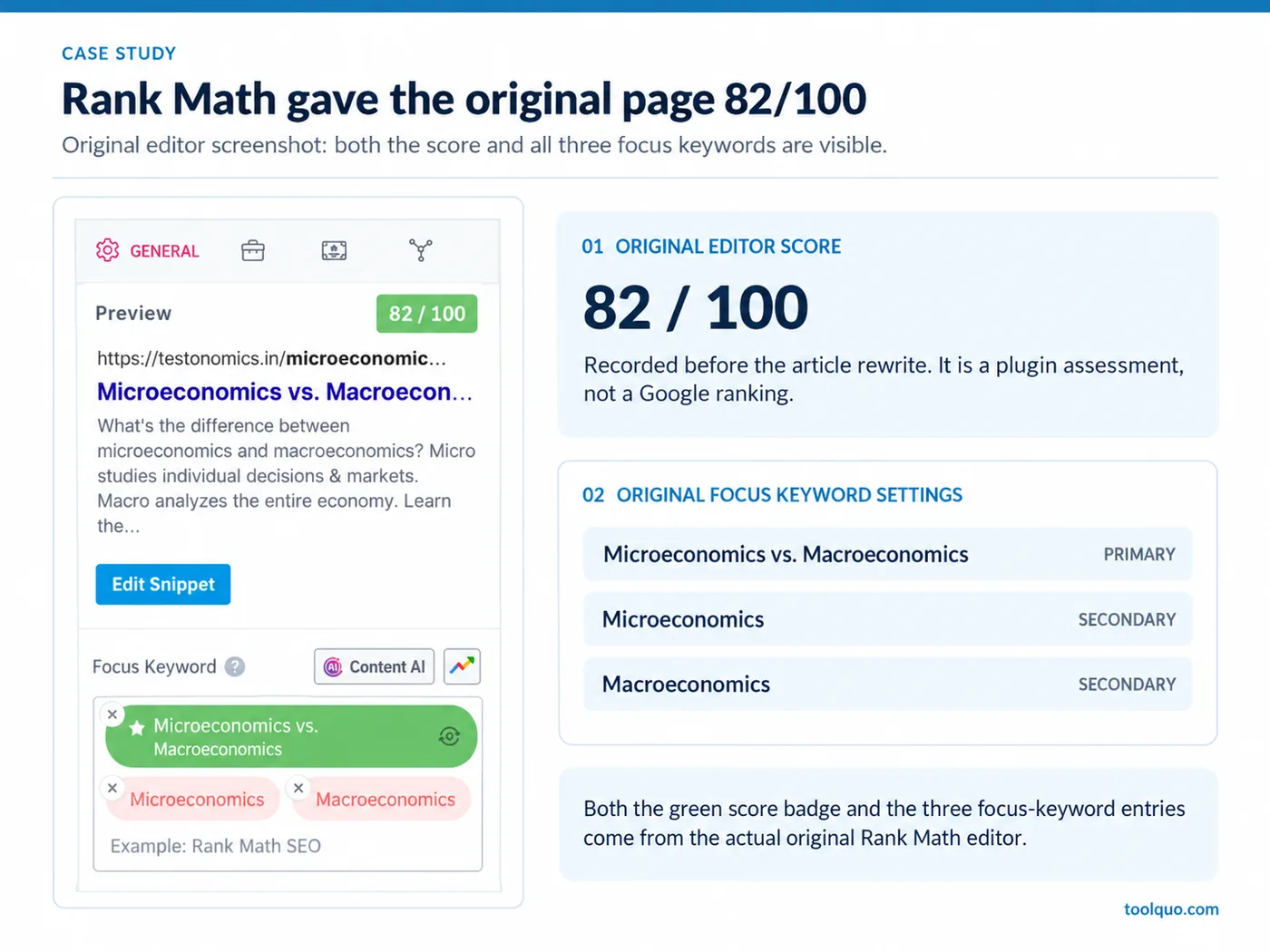
We documented the page before making changes. Rank Math’s editor showed a starting SEO score of 82/100. In WordPress, Rank Math’s Focus Keyword field sits inside its SEO panel under the General tab. The field tells Rank Math which search phrases to check in the page; it does not submit those phrases to Google. The original setup used three related focus keywords: the microeconomics-versus-macroeconomics comparison and the individual terms “microeconomics” and “macroeconomics.” This detail later proved crucial to interpreting our score.
The original article already contained examples and one comparison table, so our task was not to add substance to an empty page. But it had five H3 subheadings and no H2 headings within the body, even though the page title was supplied separately as an H1. It also contained a spelling error in the meta description and some explanations that took too long to reach their point. These were visible opportunities to improve the reading experience.
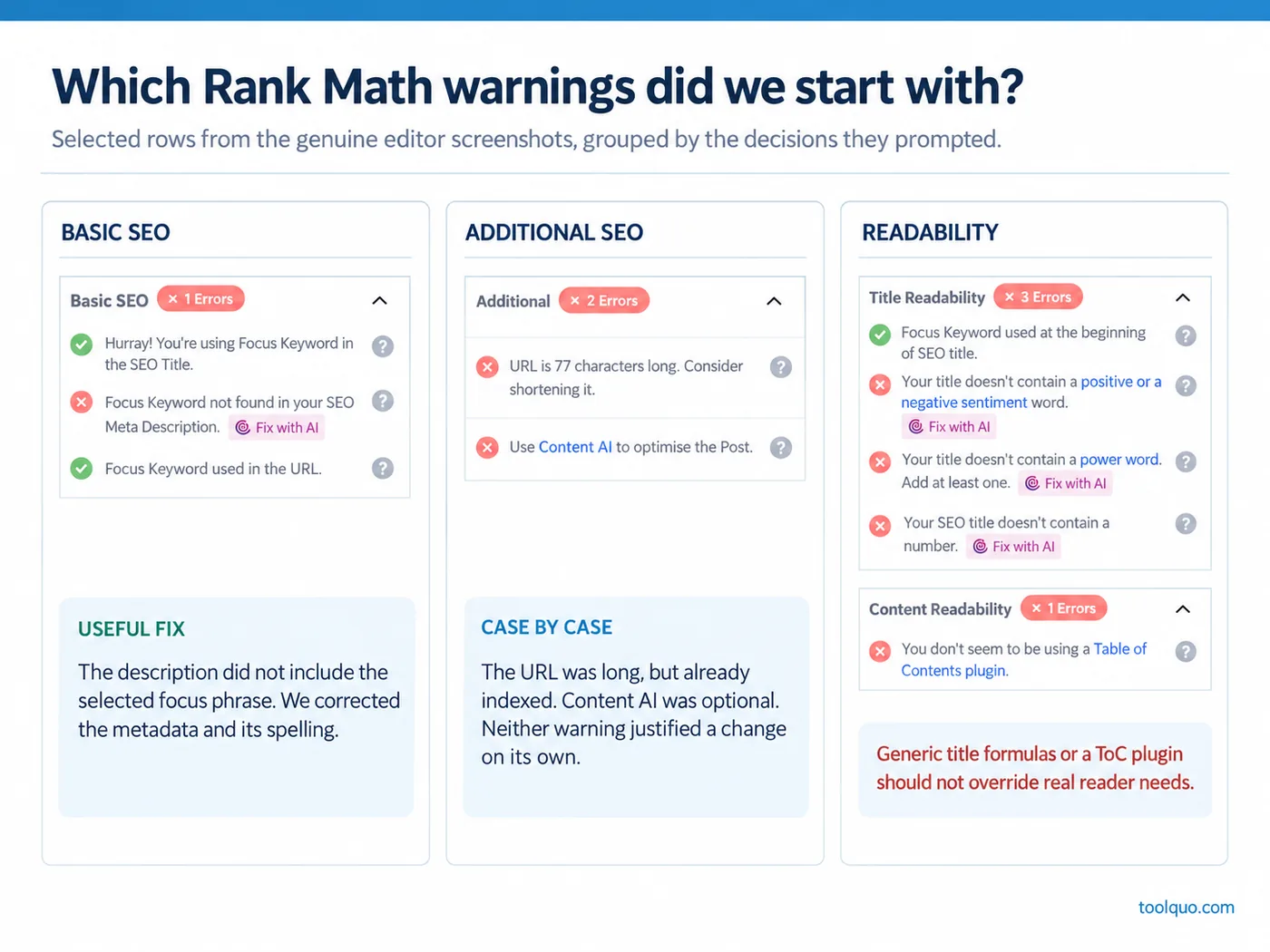
Among the problems, Rank Math flagged a missing focus phrase in the SEO description. It also suggested shortening the URL and adding certain words or a number to the SEO title. Those are very different kinds of advice: a misspelled description is a genuine editorial defect, while adding a forced “power word” to a straightforward educational title might help no one. We noted the warnings but decided their value case by case.
4. How We Planned the On-Page SEO Improvements
We started with the reader’s questions, not a keyword-density target. Someone comparing microeconomics and macroeconomics needs more than two dictionary definitions. They need familiar examples, a comparison they can scan, and help distinguishing the two perspectives in new situations. We wrote down those needs before making any WordPress on-page SEO changes.
Next, we made an outline that answered those questions in a logical order: a short definition of each subject, practical examples, a side-by-side comparison, situations where micro and macro overlap, and answers to common confusions. This also determined the page’s heading structure and where a table or infographic would help. It is a useful approach in any subject: decide what a complete answer requires, then choose the format for each part.
Google Search Console helped us see that example-based queries were important for this page. We used that information to improve the examples, not to insert every query verbatim into the text. Search keywords can reveal a reader’s question; they do not substitute for an answer.
5. How We Improved the Article’s On-Page SEO
5.1 We answered the question sooner
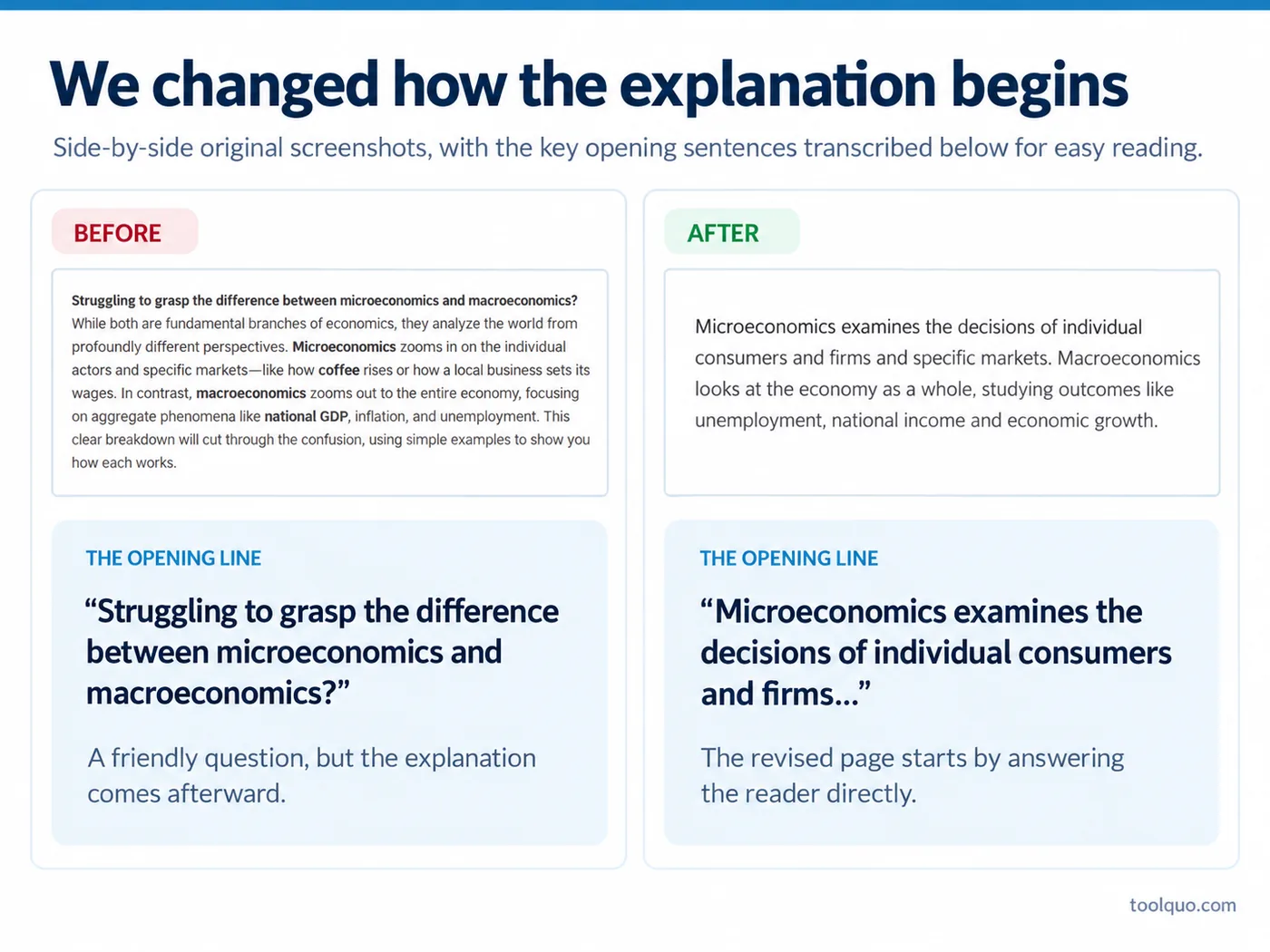
We began with the explanation itself because content is the main reason a visitor comes to a page. The original opening began with a rhetorical question: “Struggling to grasp the difference between microeconomics and macroeconomics? You’re not alone.” That was friendly, but someone searching for a definition still had to read past the setup to reach it.
The revised article begins: “Microeconomics examines the decisions of individual consumers and firms and the functioning of particular markets. Macroeconomics looks at the economy as a whole…”
The change matters because someone arriving with a simple definition question can get the answer immediately. This is a writing principle readers can copy: identify the question that brought the visitor to the page and answer it before offering background, reassurance or promotion.
5.2 We corrected the metadata, without treating Rank Math’s character counter as Google’s rule
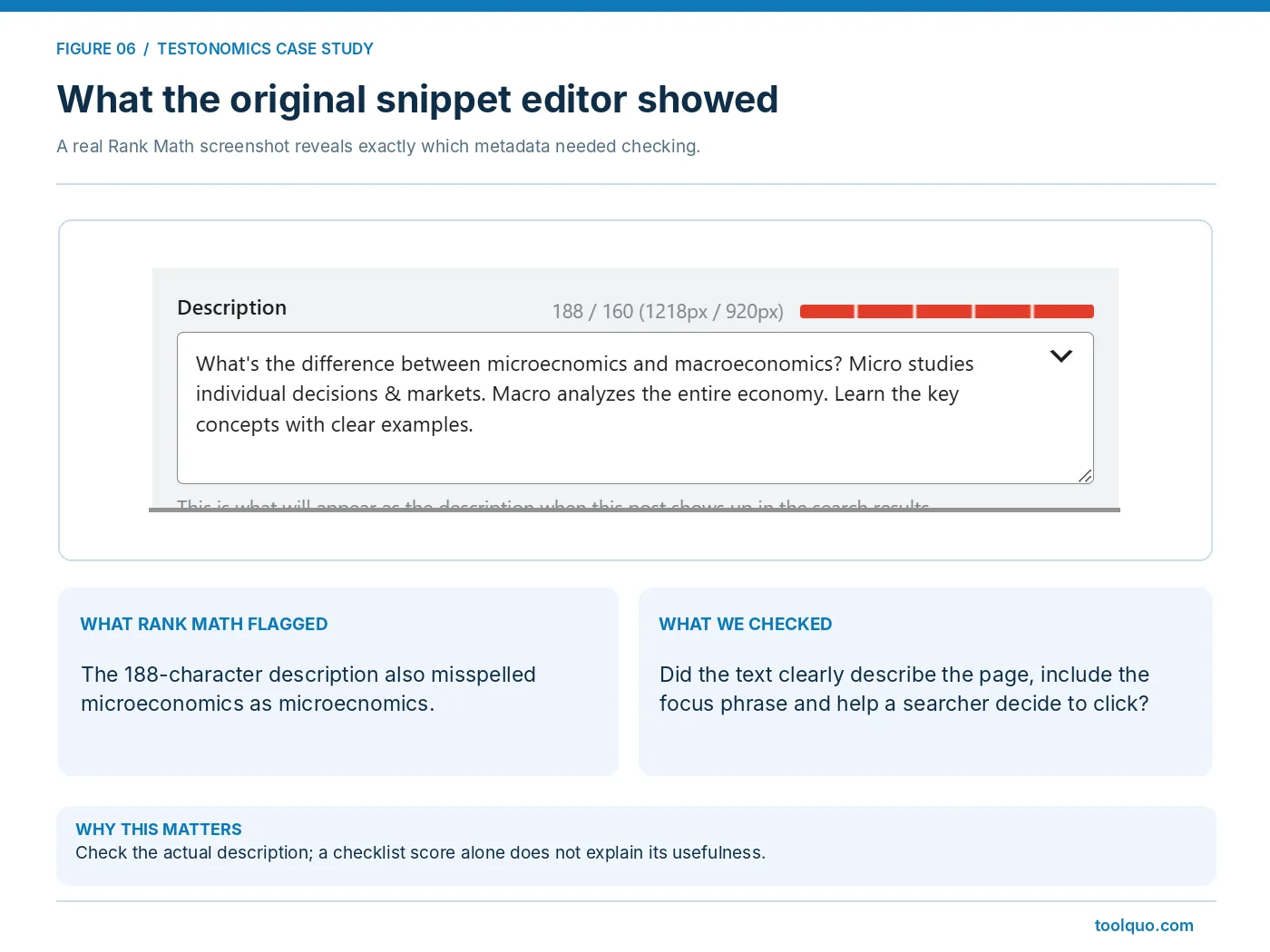
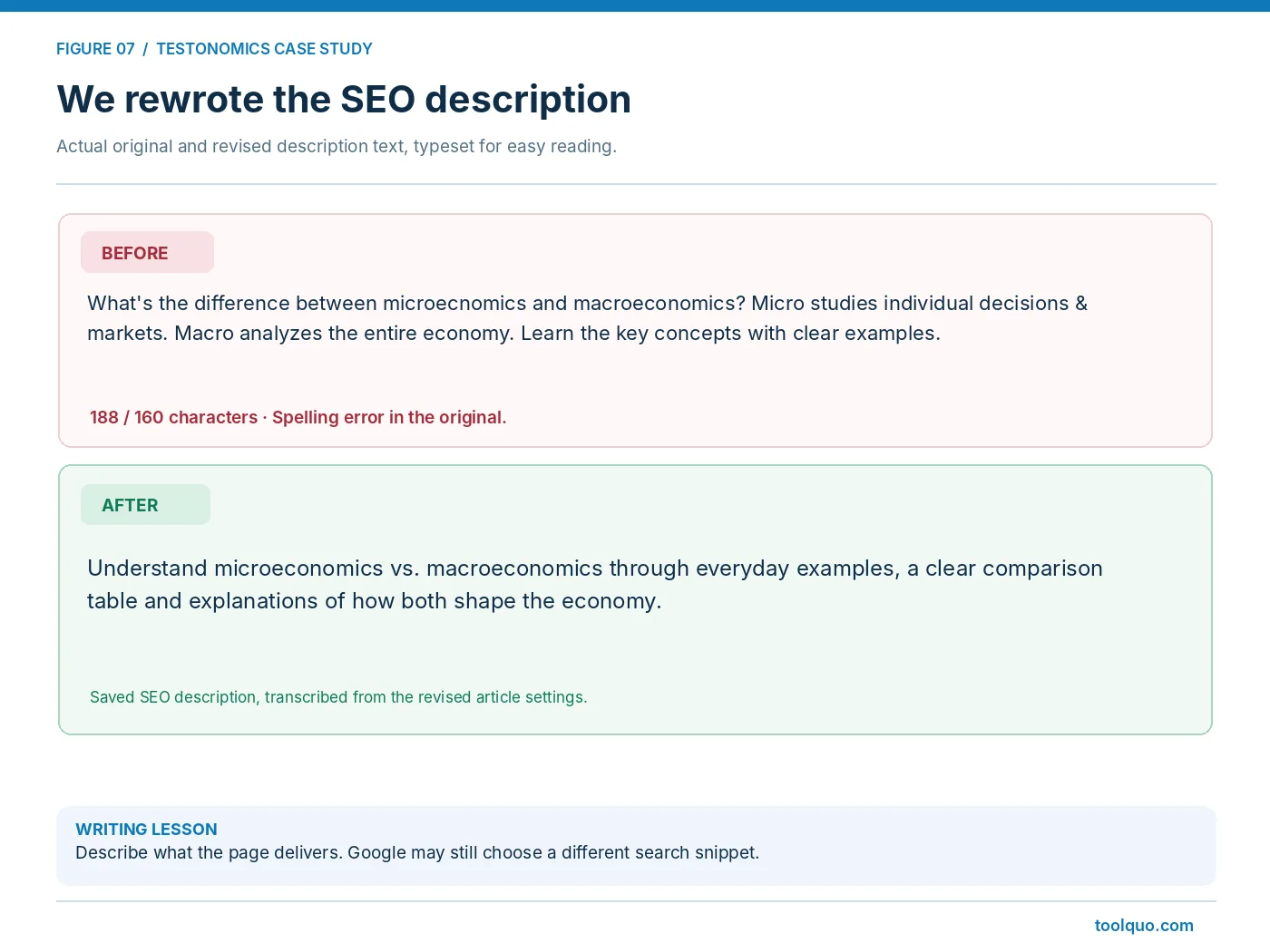
Once the explanation was clearer, we made its search-result description clearer too. The original meta description began “What’s the difference between microecnomics and macroeconomics?” and was flagged at 188 characters. It contained a spelling error and did not efficiently tell a searcher what the page provided. The revised version describes the everyday examples, comparison table and relationship between the two branches. This is the kind of metadata edit worth making even if no score were displayed.
This was a genuine quality fix. It improved the page’s authored search preview and removed an avoidable error. However, Google may generate a snippet from the page itself rather than display our description, so we cannot claim the edited text necessarily appeared to every searcher.
5.3 We rebuilt the page around explanations and evidence
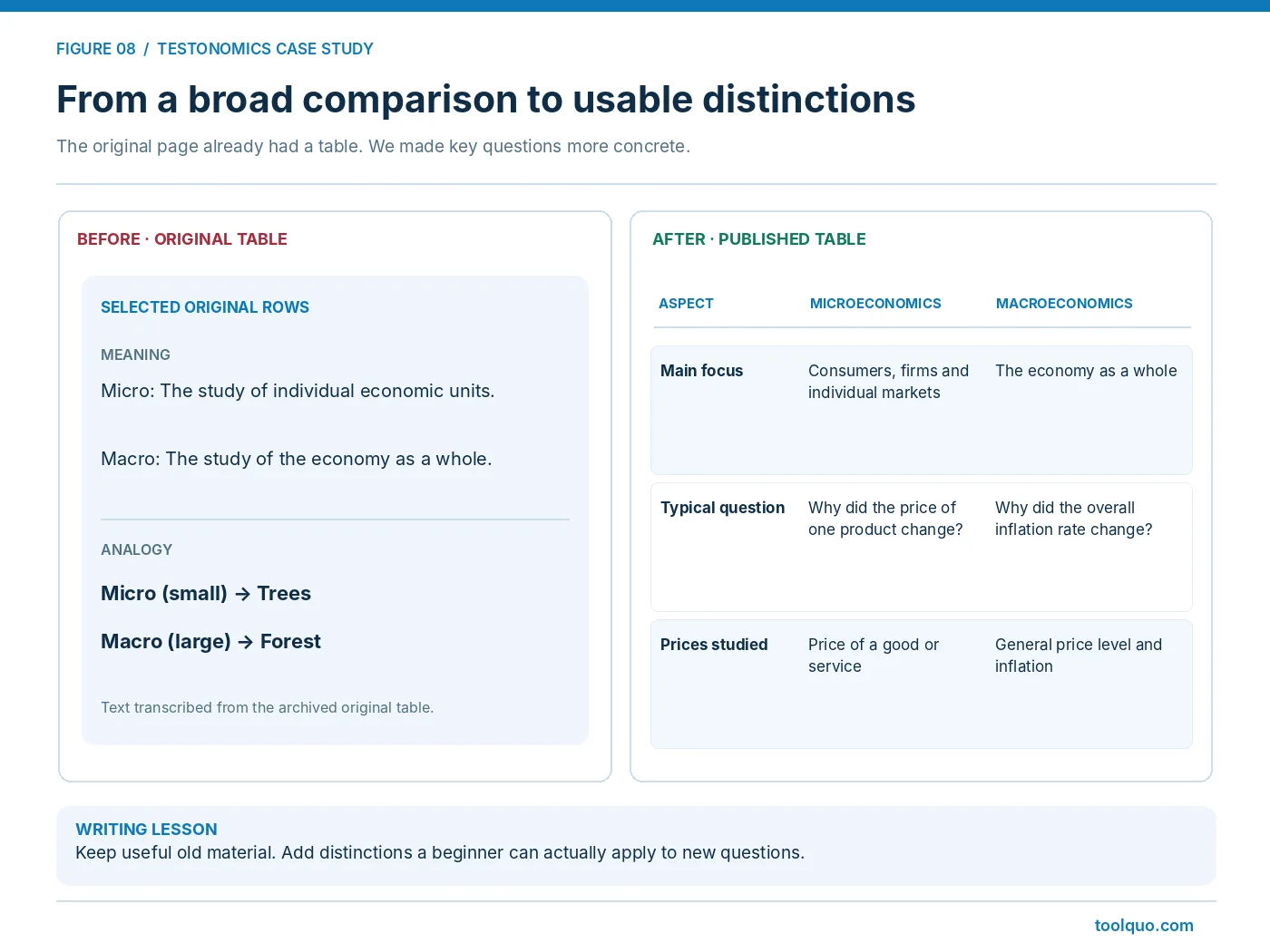
The original article already offered microeconomic and macroeconomic examples, including avocado prices, hiring and economy-wide inflation. We did not pretend to invent examples for the first time. We made the distinctions easier to see and removed the need for current-event assumptions that could quickly become inaccurate.
For example, a microeconomic question can ask why tomato prices rise when supply falls in one market. A related macroeconomic question asks why the overall price level is rising. We also added questions involving business hiring, a product-specific tax, India’s GDP growth and RBI interest-rate policy. The questions were framed as illustrations, not unsupported claims that these events were currently happening.
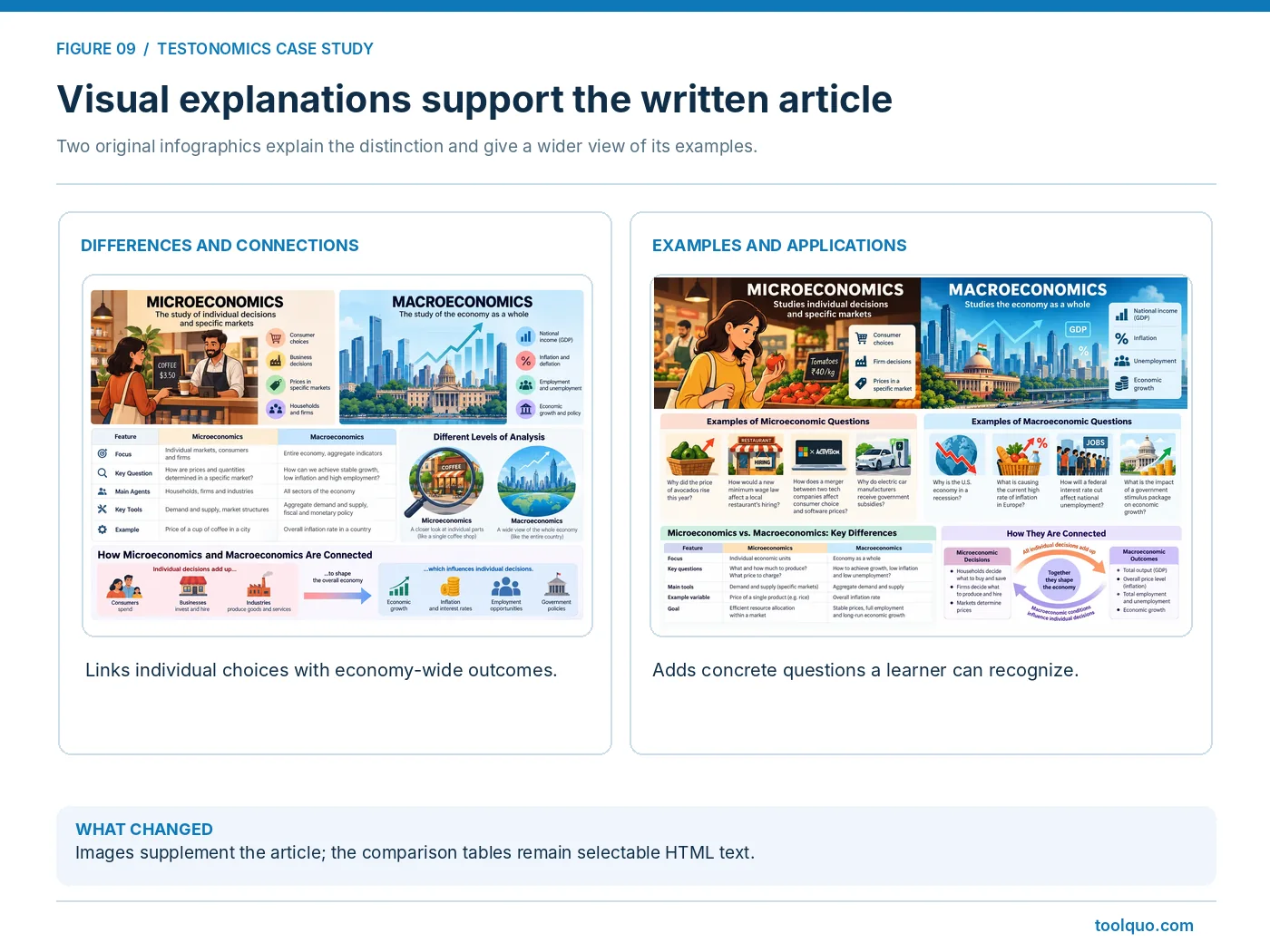
We preserved the original side-by-side comparison table, improved its explanations and added another table that shows how the same event can be examined from both perspectives. This gave readers a way to scan the differences before reading the more detailed examples. We also included two educational infographics, while keeping both tables as selectable text instead of turning them into inaccessible screenshots.
5.4 Clear headings and a working table of contents
The original body had five H3 subheadings and no H2 headings. We reorganized it into eight main H2 sections and six H3 subsections. The page title remained the H1. This clearer hierarchy makes the article easier to scan and shows which explanations belong under each main topic.
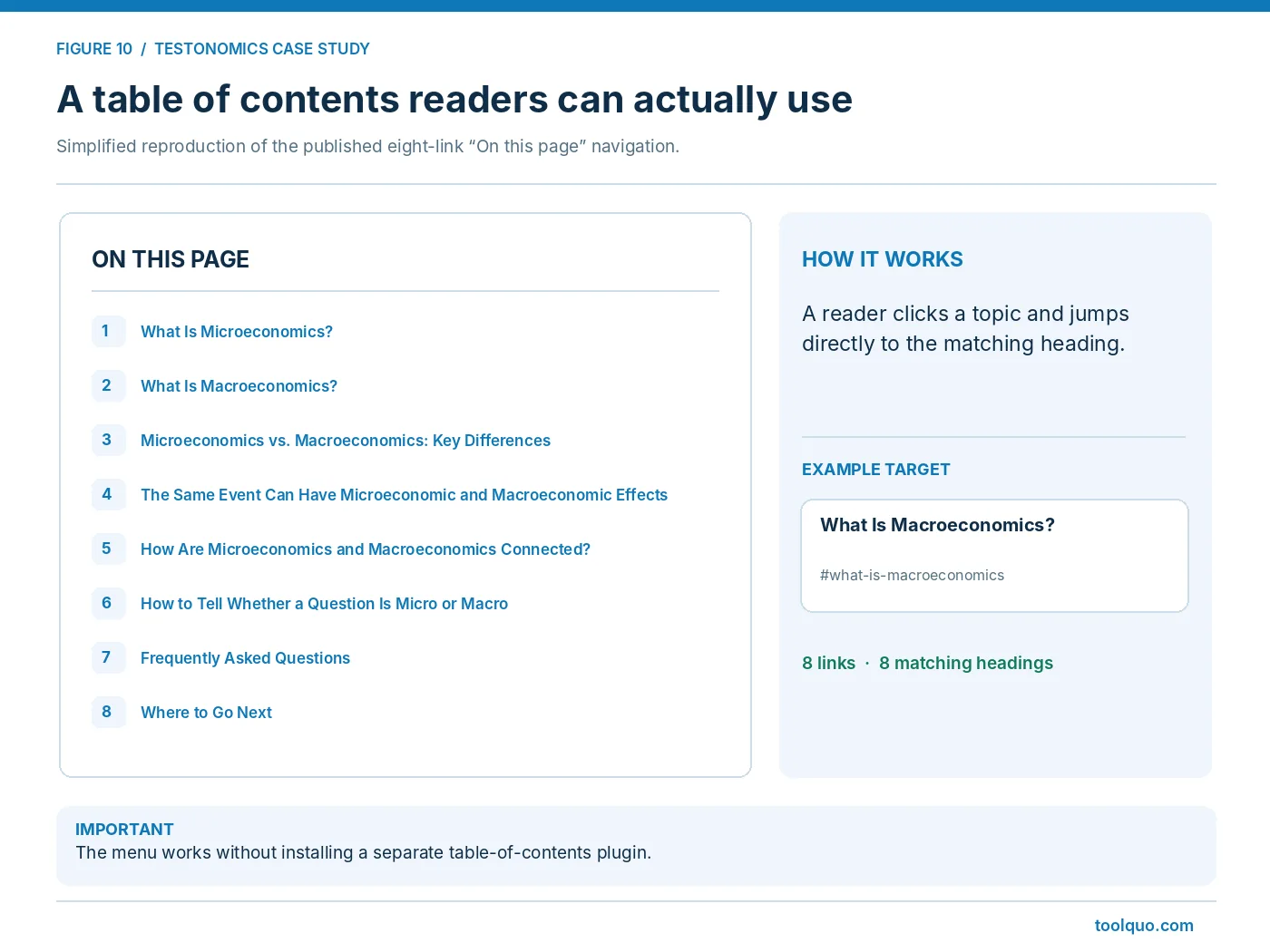
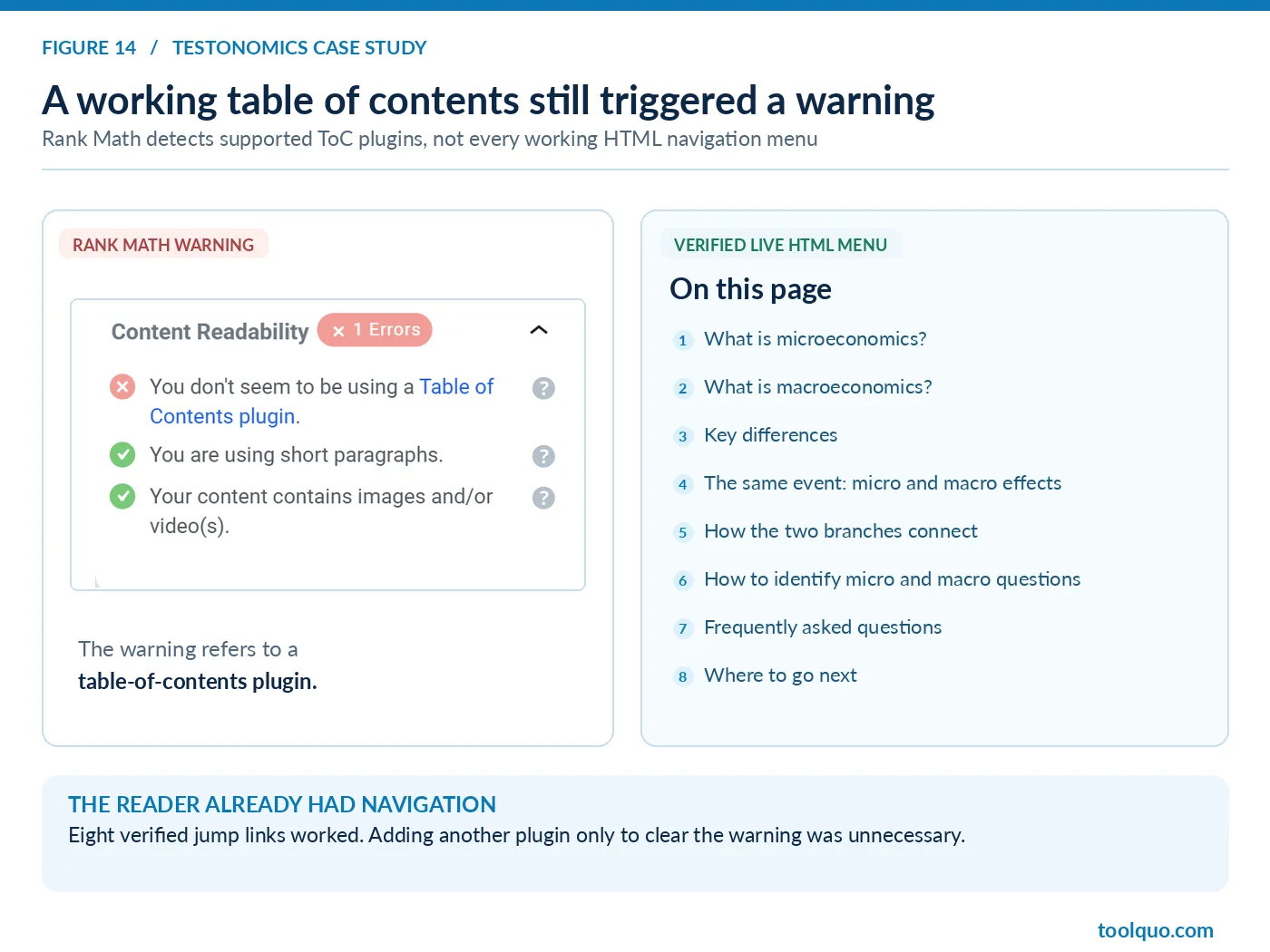
We then added a small table of contents titled “On this page” after the introduction. Each of its eight clickable links jumps to a main section. A reader looking for a definition, examples or FAQs can now go directly to that part of the page. We built the table of contents using simple HTML links, without installing another plugin, and verified all eight destinations on the published page. Rank Math’s plugin-detection warning is discussed later.
5.5 We improved internal linking, not just outbound link counts
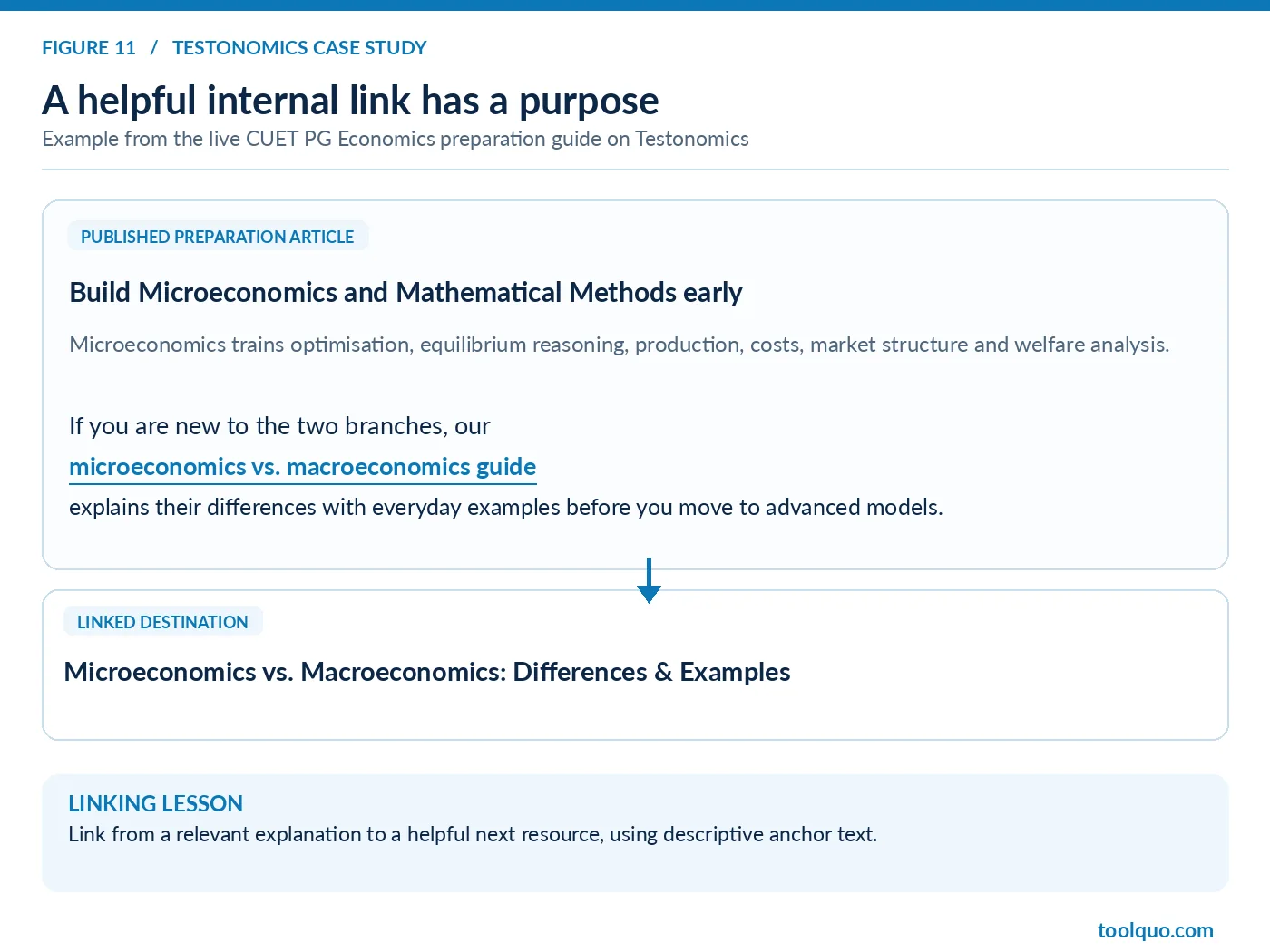
We added three relevant links pointing to this article from existing Testonomics guides: CUET PG Economics Preparation, a Six-Month Study Plan and the CUET PG Economics Syllabus. We placed them where a reader learning economics foundations would plausibly want a beginner-friendly comparison.
A link from one page of Testonomics to another is an internal link, not a backlink from an independent website. Internal links can help a visitor move from a preparation plan to a relevant explanation and can help search engines discover connected content. We checked that all three links appeared on the published pages and pointed to the intended article. We have not measured any ranking gain from these additions.
6. The Rank Math SEO Score Experiment: 82 → 81 → 87
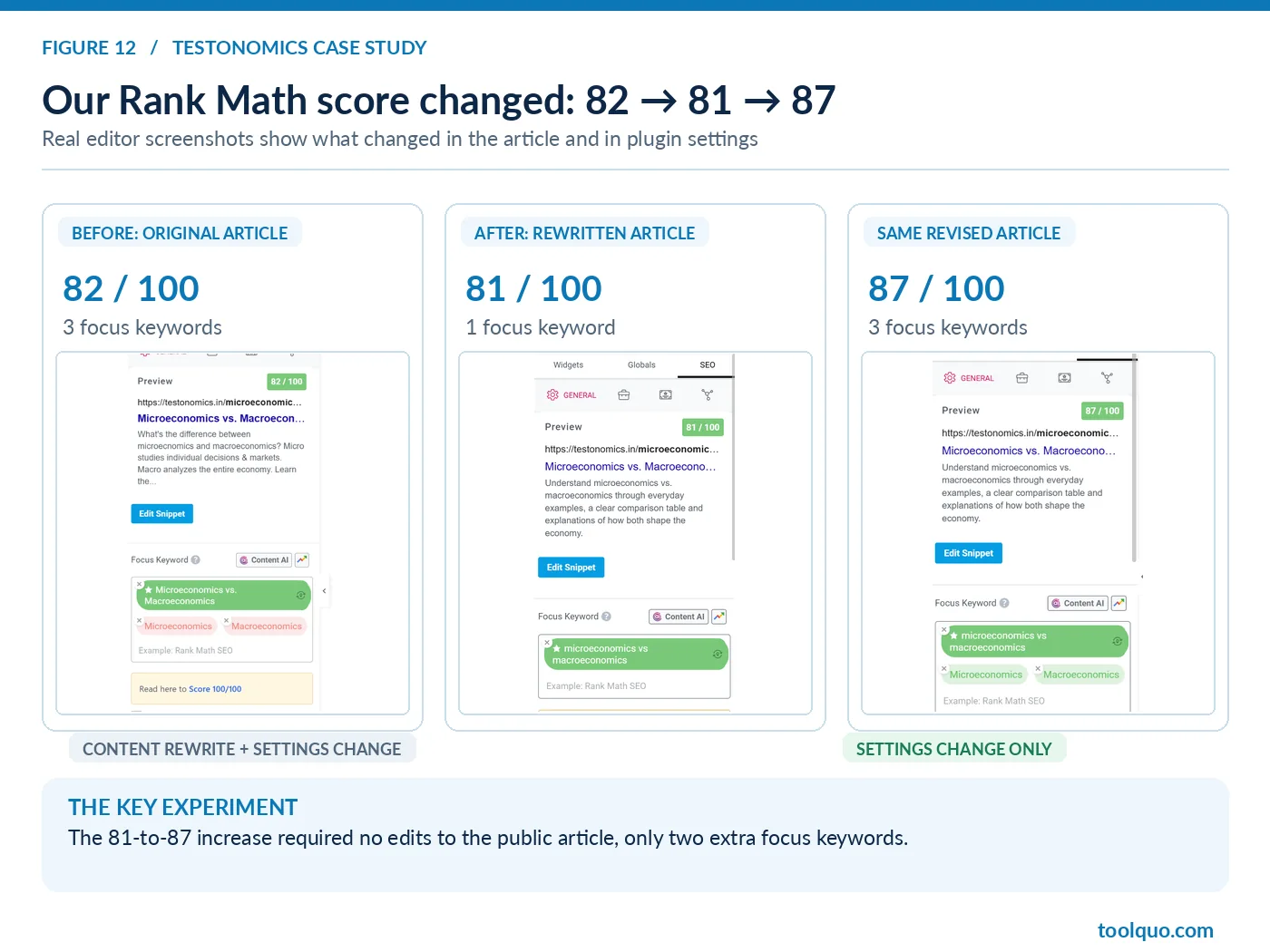
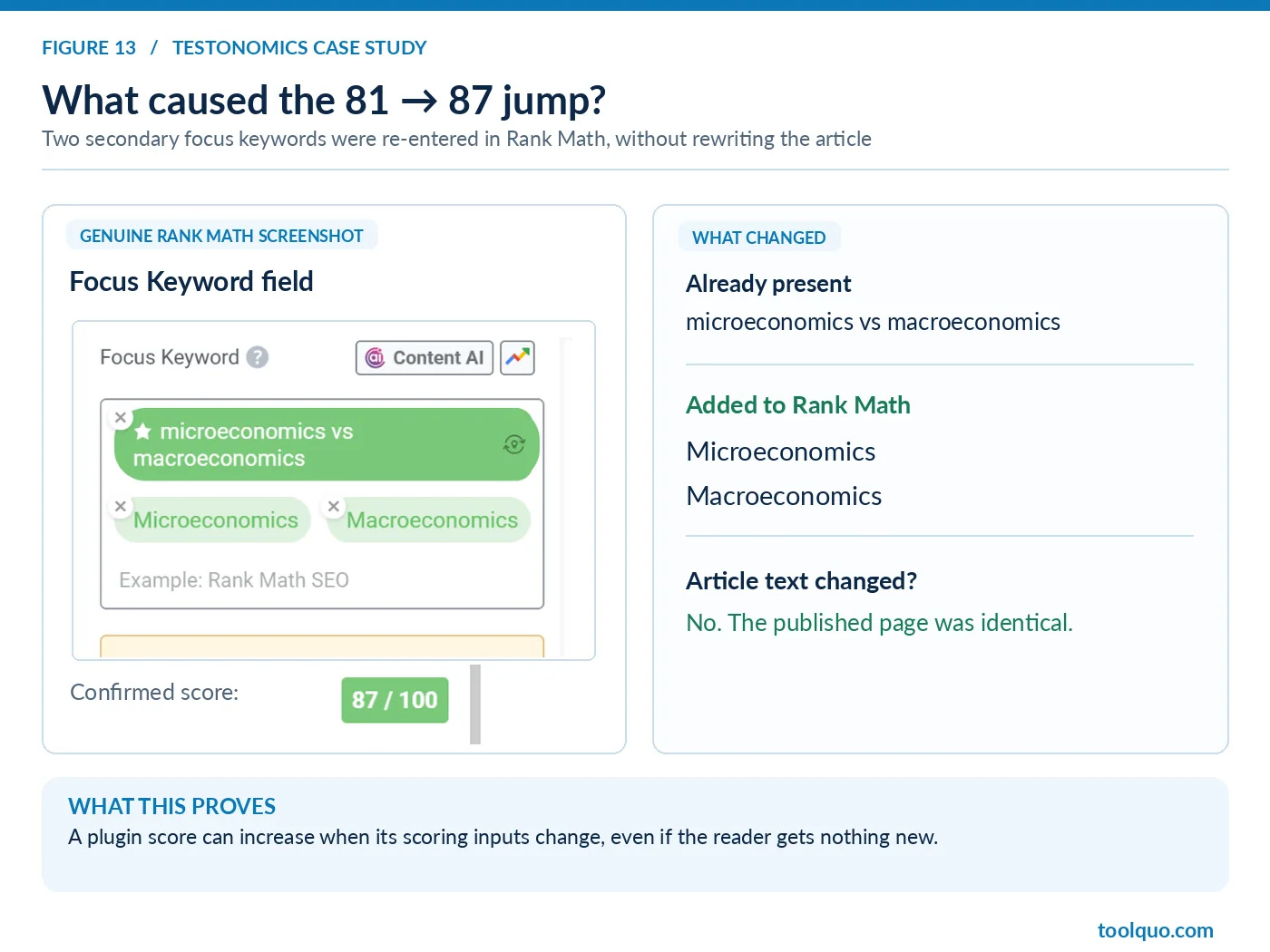
After our content and on-page SEO edits, we expected Rank Math to acknowledge at least some improvements. Instead, the editor displayed 81/100, one point below the starting score of 82. Before deciding whether the changes had made the page worse, we checked what Rank Math was actually measuring. We discovered that only one focus keyword was entered in Rank Math’s Focus Keyword field for the revised page, compared with three in the original. That made the two scores less comparable.
To test the effect of those settings, we opened the article in WordPress with Elementor, opened the Rank Math SEO panel, selected General, and located the Focus Keyword field. The primary phrase “microeconomics vs macroeconomics” was already there. We added the original two secondary terms, “Microeconomics” and “Macroeconomics,” and pressed Enter after each. We did not edit a paragraph, heading, image, page URL, SEO title or meta description. Rank Math recalculated the same revised article at 87/100. We saved and reopened the editor, and 87 remained.
| Stage | Rank Math score | Focus keywords |
|---|---|---|
| Original article (editor) | 82/100 | 3 |
| Revised article | 81/100 | 1 |
| Same revised article, restored keywords | 87/100 | 3 |
The six-point increase is the most revealing result of this experiment. For visitors, the article at 81 and the article at 87 were identical. The search engine was not given an improved explanation, an extra example or any new text. What changed was Rank Math’s private checklist: it now evaluated the article against two additional terms already present in the content. The score rose because the scoring configuration changed, not because we had made the page more useful.
This does not invalidate Rank Math as a tool. Some checks can identify genuine mistakes, as our meta-description typo showed. Nor does the 82-to-87 before-and-after score prove higher search rankings, because we made many editorial changes in between. What the 81-to-87 comparison demonstrates directly is that six points of this increase required no improvement whatsoever to the published article. That is exactly why we should not treat the plugin score as a measure of content quality.
We observed a related distinction in our Yoast SEO score experiment: entering the focus keyphrase and saving metadata changed the analysis of an existing article. That test helps separate information supplied to the plugin from improvements to the published explanation.
At 87, Rank Math counted 57 occurrences across our three focus keywords and their combinations, with a displayed density of 1.96%. Those numbers are plugin outputs, not proof that an exact phrase has the right frequency or that Google will reward the page.
6.1 Does Rank Math score affect Google rankings?
No. The Rank Math SEO score is a rating calculated inside the WordPress plugin, not a ranking score supplied by Google. Google does not use Rank Math’s numeric score as a ranking factor. However, some of the underlying improvements a checklist recommends, such as useful content, descriptive headings and helpful internal links, can improve how well a page serves readers and how clearly search engines can interpret it. That is why a checklist item deserves evaluation, but a higher number alone does not establish better rankings. Our unchanged article jumping from 81 to 87 after two focus keywords were added to the plugin makes that distinction particularly clear.
7. Why We Did Not Chase a Perfect Rank Math Score
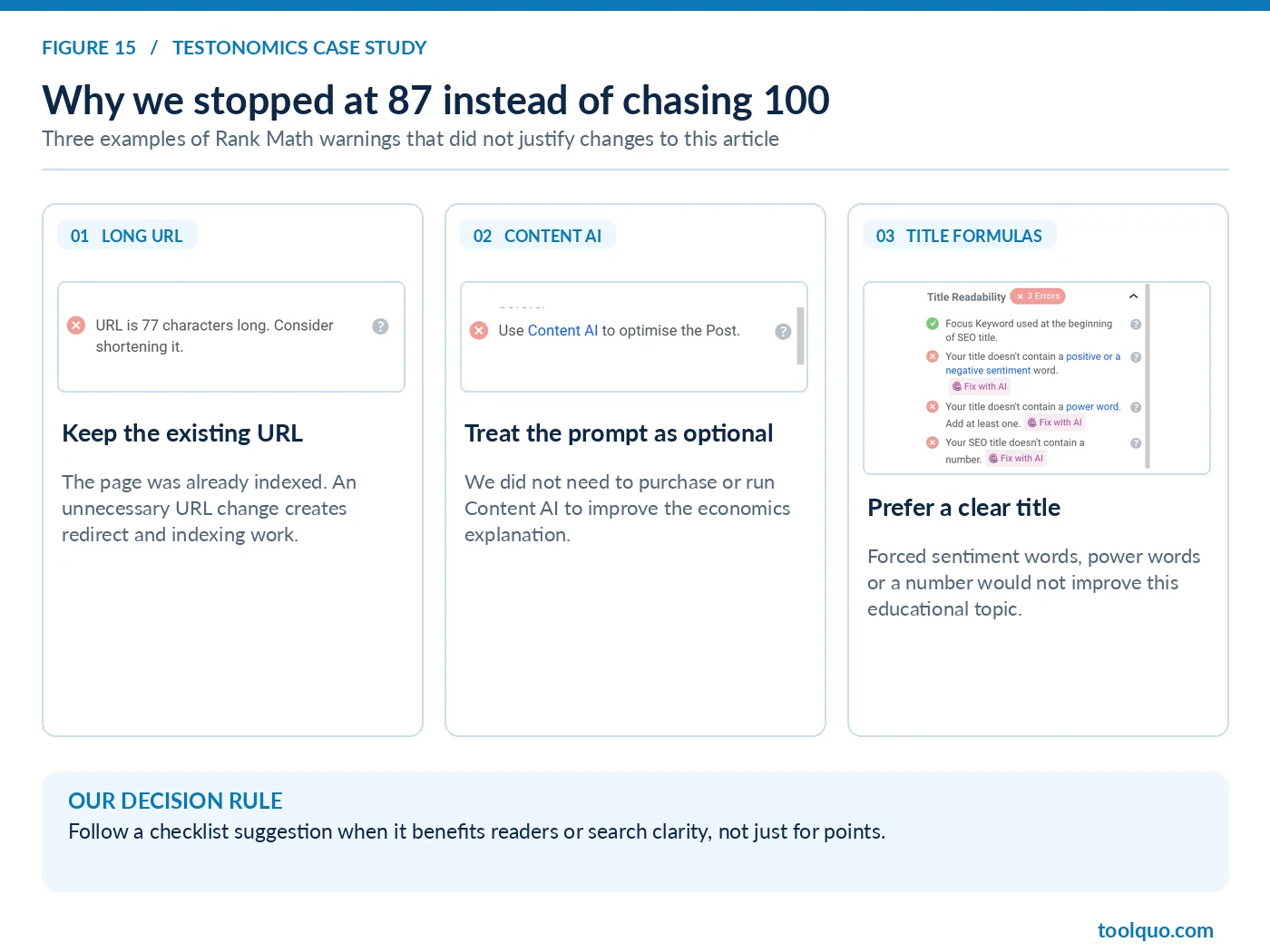
We stopped at 87 rather than chase 100 because every remaining warning needed a reader-benefit test. Changing a functioning URL, forcing promotional-sounding words into an economics title, or installing another ToC plugin would have been changes made for the plugin, not for the article. A score of 100 would make a neater screenshot, but it would not prove that we had helped readers or improved Google performance.
At 87/100, the Basic SEO checks passed. The remaining items in Rank Math’s SEO checklist covered URL length, optional Content AI, title wording and table-of-contents detection. Some can be useful in other circumstances. Here, we examined whether each proposed change would actually help someone reading or finding the article. A red or orange plugin warning was not enough reason to edit the page.
| Warning | Decision | Why |
|---|---|---|
| URL 77 characters | Keep existing URL | Avoid an unnecessary move of an existing indexed page. |
| Use Content AI | Ignore | No demonstrated need to run an AI product to improve the text. |
| Add sentiment word | Ignore | Forced emotion would weaken a neutral comparison title. |
| Add power word | Ignore | The educational title is already descriptive. |
| Add a number | Ignore | No natural numbered claim belongs in the title. |
| ToC plugin not detected | Keep our manual ToC | Eight verified jump links work without a recognized plugin. |
The table-of-contents warning is the clearest example. Our published page already has a working table of contents with eight clickable section links. Nevertheless, Rank Math can still show a warning about a missing table-of-contents plugin. Its test recognizes supported plugins rather than every navigation menu created directly in HTML. Installing another plugin solely to clear that warning would add complexity without helping readers reach the sections they need.
The remaining title warnings tell a similar story. Our page compares two economics concepts, so a clear title such as “Microeconomics vs. Macroeconomics: Differences & Examples” is more appropriate than an artificial number or emotional phrase. We kept its existing URL because a change would require redirects and introduce unnecessary migration work. We also did not use the optional Content AI feature merely to satisfy a plugin prompt. Each time, we asked whether following the suggestion would improve the actual page.
8. A Beginner’s On-Page SEO Checklist for Any Article
This on-page SEO case study uses an economics article, but the method works for a software review, a gardening guide, a travel article or another subject. The details differ, but the writer still needs to identify the reader’s question, supply evidence, arrange the answer and check its clarity. Google’s people-first content guidance similarly emphasizes helping visitors accomplish their goals.
Step 1: Define the reader and the task. Are they trying to learn a concept, choose a product, fix a problem or compare options? The opening should solve the most immediate part of that task.
Step 2: Examine real questions. Use Search Console if the article already receives impressions. Look at relevant queries, on-site questions, reader feedback and competing results. Separate broad intent from narrow subquestions. Do not assume every low-CTR query needs keyword repetition.
Step 3: Make an answer map. Write one line for the central answer, then list the essential concepts, practical examples, comparisons, exceptions and common misunderstandings a complete explanation requires. For a product review, this may mean price, features, limitations and firsthand testing. For a medical explainer, it may mean definitions, when to seek professional care and carefully sourced cautions.
Step 4: Choose the right presentation for each answer. Use a paragraph to explain a mechanism, a list for steps, a table for repeated comparisons and an image only where a visual makes something easier to understand. Keep charts and tables readable, editable and accessible wherever possible.
Step 5: Edit for accuracy and reading flow. Remove vague openings, unsupported current-event claims, duplicate explanations and marketing detours. Give headings meaningful names. Use terms naturally rather than counting repetitions as a writing objective.
Step 6: Run the Rank Math SEO checklist, or the equivalent checklist in your SEO plugin. Use it to catch omissions such as missing metadata or inconsistent headings. Then review the warnings critically. If a recommended change does not improve the page, record why you are leaving it alone rather than adjusting text purely for points.
Finally, check your decisions as if the plugin were switched off. Would a faster answer, more accurate example, clearer comparison or working internal link still help a real visitor? If yes, the edit deserves attention. If the only benefit is changing a colored indicator in Rank Math, reconsider. For help choosing among plugin features more broadly, our Rank Math review examines the software itself, while our Best SEO Tools guide compares different types of SEO tools.
9. What This On-Page SEO Case Study Does, and Does Not, Prove
We can verify the revised page’s new copy, corrected description, clearer heading hierarchy, two HTML comparison tables, added visuals, functional ToC and three contextual inbound internal links. We can also verify the editor score history: 82, then 81 with one focus term, then 87 after restoring the two secondary terms.
We cannot yet demonstrate that the page earned more clicks, a higher average position or a better click-through rate in Google. The 5,268 impressions and 12 clicks belong to the July–September 2026 baseline, before the intervention. No later Search Console comparison is presented as an outcome here.
We will review Google Search Console after enough time has passed, using stated, comparable date ranges and the same exact-page filter. Any changes in traffic may also reflect demand, seasonality, competitors and Google’s own systems. This is a documented before-and-after editorial experiment, not a causal test of rankings.
10. What We Learned About Rank Math and On-Page SEO
If you are ready to apply these ideas on your own WordPress site, see our step-by-step Rank Math SEO tutorial for installation, setup, module choices and article optimization.
Rank Math helped us notice a real metadata problem and organize an on-page SEO review. But it could not decide whether an economics explanation was accurate, whether a comparison was genuinely useful, or whether a manually created contents menu worked. Those judgments required familiarity with the subject, attention to the reader’s questions, and direct verification on the live page.
An 87/100 score may be a useful checkpoint, but it is not the outcome that matters most. We improved observable aspects of the page, stopped when further checklist changes lacked a clear purpose, and preserved the baseline for a later Google Search Console comparison. The lesson is not to disregard Rank Math. It is to let the plugin support thoughtful on-page SEO work rather than dictate what you publish.
If you’d like to know whether Rank Math itself is the right WordPress SEO plugin for you, our hands-on Rank Math review discusses its features, strengths and limitations. If you are still learning the basics, start with our What Is SEO? guide. We’ll also connect this case study to our forthcoming practical on-page SEO guide and detailed Rank Math setup tutorial as those articles are published.
About the author
Nikhil Bhardwaj
Founder & Editor, Toolquo
Nikhil leads Toolquo’s editorial direction, focusing on practical software research, transparent comparisons, and clear buying decisions.
View author profile →Keep exploring
Related guides
November 3, 2026
Yoast SEO Sitemap: How to Find, Configure and Fix Errors (2027)
Find your Yoast SEO sitemap, choose which URLs belong in it, submit it to Google Search…
November 1, 2026
How to Use Yoast SEO: Complete Beginner’s Guide (2027)
Learn how to install and configure Yoast SEO, choose WordPress SEO settings, optimize a post, and…

October 29, 2026
Yoast SEO Review (2027): How Good Is It, and Is Premium Worth It?
Our hands-on Yoast SEO review explores Free features, Premium pricing, strengths, limitations, and whether upgrading is…