SE Ranking Review (2027): Hands-On Tests, Pros, Cons & Pricing
We tested SE Ranking on real websites. Read our findings on keyword research, competitor analysis, rank tracking, website audits, AI visibility, pricing, and limitations.
On this page
Testing disclosure: Based on SE Ranking trial testing in October 2026. Features we could not independently verify are identified in the review.
1. Quick Verdict: Is SE Ranking Worth Using?
In this SE Ranking review, we examine keyword research, competitor analysis, rank tracking, technical audits, backlink analysis, content optimization and AI search monitoring using real websites. Our aim is to assess how well these features work in practice, not simply count the features listed by the company.
Our verdict: SE Ranking deserves consideration if you regularly work on SEO, especially for an established website, a freelance client or an agency. We found its competitor research, keyword filters and daily ranking reports particularly useful. Its AI search tracker also let us inspect actual responses mentioning a brand.
There are limitations. The default keyword suggestions included a surprising number of unrelated searches. Content Editor sometimes encouraged changes that would make an article longer without necessarily making it better. And some paid functions could not be fully assessed with our trial account.
At A Glance
- Best for: established bloggers, in-house SEO teams, freelancers and agencies.
- Most useful in our testing: competitor research, narrowing keyword gaps, tracking rankings and inspecting AI mentions.
- Watch out for: estimated metrics, irrelevant suggestions, formulaic content recommendations and trial restrictions.
- Starting price at our October 2026 check: Core, $129/month; discounts were available for annual payment.
- Trial: 14 days; our signup required a work or business email.
- Our rating: no numerical score yet. We want a consistent benchmark across several SEO tools first.
For a new blog with only a few articles, free products such as Google Search Console may be enough. The right question is whether SE Ranking will help you regularly make better SEO decisions, not how many features it advertises. For other options, see our guide to the best SEO tools. If you mainly need to implement SEO settings within WordPress rather than research keywords or competitors, our Rank Math review examines that different role through hands-on tests.
Want to try it yourself? Explore SE Ranking’s 14-day free trial.
2. What Is SE Ranking, and How Does Its Interface Work?
SE Ranking is online SEO software. You use it to research what people search for, investigate other websites, monitor your own Google rankings and identify problems on your site. Features include Keyword Research, Competitive Research, Rank Tracker, Website Audit, Backlink Checker, Content Editor and AI Results Tracker.
You do not need to use every feature, and you do not need to buy a separate product for each everyday SEO task. The functions are available from the SE Ranking platform, although particular allowances and advanced features depend on your subscription.
2.1 Understanding the dashboard as a beginner
The easiest way to understand the interface is to think of two common tasks:
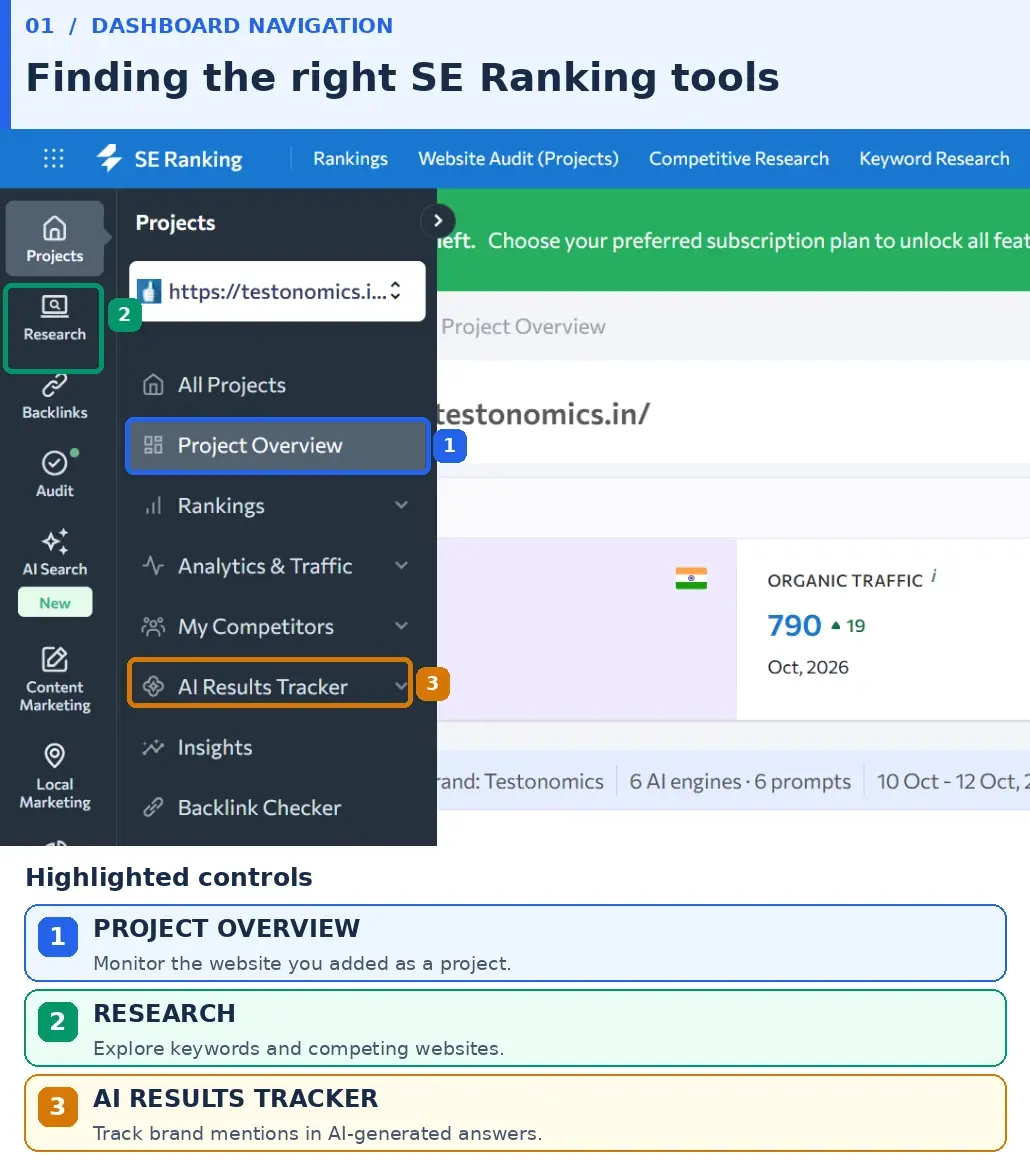
- Monitor your own website. Add your domain as a PROJECT. Choose the keywords, location, device and search engine you want to track. SE Ranking then displays ongoing project information, such as rankings, website audits and other monitoring results.
- Research a keyword or another website. Open a research feature from the main navigation. For example, choose KEYWORD RESEARCH to investigate a phrase or COMPETITIVE RESEARCH to investigate a domain. You can research a competitor without owning its website or connecting its private analytics account.
Other areas, such as Content Editor and AI Results Tracker, provide more specialized workflows within the same platform. You can move from a summary chart into more detailed tables, then use filters to narrow down the results.
For example, Competitive Research estimates the terms a domain ranks for across its database. Rank Tracker instead follows the specific keywords and search conditions you choose for an ongoing project. They answer related, but different, questions.
2.2 How we judge an SEO tool
An SEO platform is useful when its information helps you make a decision: which search term to target, which technical issue to fix, or which ranking change deserves investigation.
We consider four things: (1) how relevant and understandable the information is, (2) how useful the functions are in practice, (3) what usage allowances the subscription provides, and (4) the total cost.
Remember that each SEO software company estimates metrics such as keyword search volume, Keyword Difficulty, competitors’ organic traffic and authority scores using its own data and methods. These figures can vary across platforms. They are not exact counts directly supplied by Google, and a higher proprietary score does not automatically mean a better website.
In the following sections, we’ll evaluate SE Ranking against these considerations using our test results.
3. SE Ranking Keyword Research: Useful Suggestions or Too Much Noise?
Our finding: SE Ranking offers useful keyword metrics and a large pool of suggestions. Its Relevance filter made those suggestions far more useful by removing many unrelated results.
Keyword research begins with a question: what are people searching for, and which questions could our website answer well? The results can also help us refine existing content to better meet readers’ needs. A good tool should reveal demand, competition and related questions without treating every loosely related phrase as a worthwhile article idea.
3.1 How to use Keyword Research
Open KEYWORD RESEARCH, enter a phrase and choose a country. SE Ranking displays metrics including:
- Search Volume: estimated average monthly searches in the selected country.
- Global Volume: its estimated searches across countries.
- Keyword Difficulty: SE Ranking’s estimate of how hard it may be to rank organically.
- Search Intent: the likely purpose of the query, such as finding information or buying something.
- CPC: estimated cost per click in paid search advertising.
You can then explore Similar Keywords, Related Keywords and Questions. Filters for relevance, volume and difficulty help turn a large list into a manageable shortlist. Before writing, you should still inspect the actual search results and decide whether your article would satisfy the searcher’s intent.
3.2 Our test: “best seo tools”
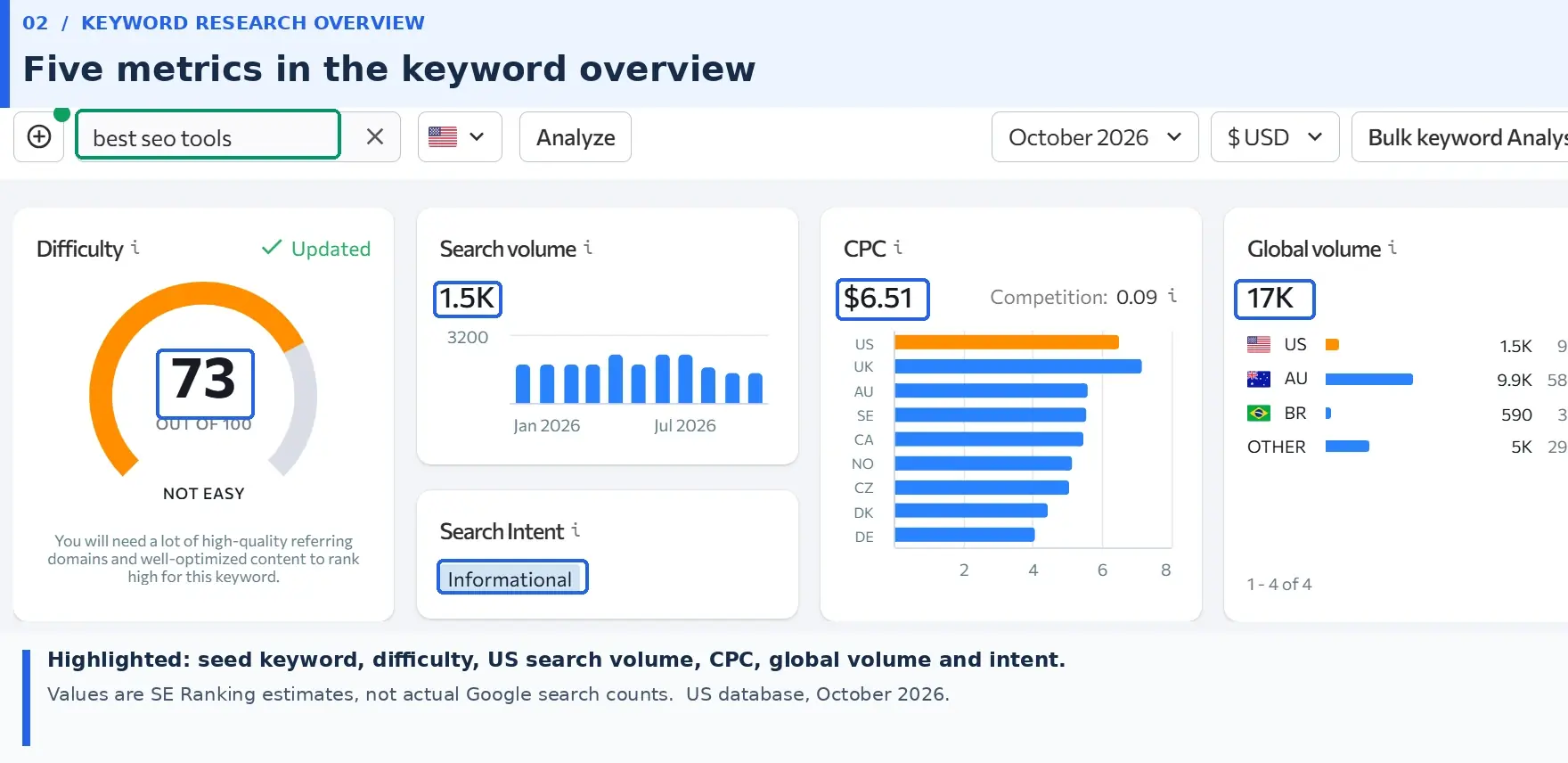
We entered “best seo tools” in SE Ranking’s United States database to assess how well the tool handled a realistic SEO keyword query. The overview estimated:
- US search volume: 1,500 per month; global volume: 17,000.
- Keyword Difficulty: 73 out of 100.
- CPC: $6.51.
- Search intent: informational.
These numbers provide a starting point; we did not independently confirm the underlying search counts.
The bigger lesson came from RELATED KEYWORDS. SE Ranking produced 47,546 suggestions, including clearly off-topic phrases such as “best workout routine”, “best credit card points” and “best survivor seasons”. Related Keywords partly reflects overlapping Google results, not necessarily the meaning of a phrase, so a loose connection can generate irrelevant matches.
We applied the Relevance filter:
- No minimum filter: 47,546 results, with many unrelated phrases.
- Minimum 25% relevance: 562 results, a reduction of about 98.8%.
- Minimum 50% relevance: zero results in this test.
The 25% list contained more plausible terms such as “seo software”. Even there, some searches were for services rather than software, so we would not automatically target them in the same article.
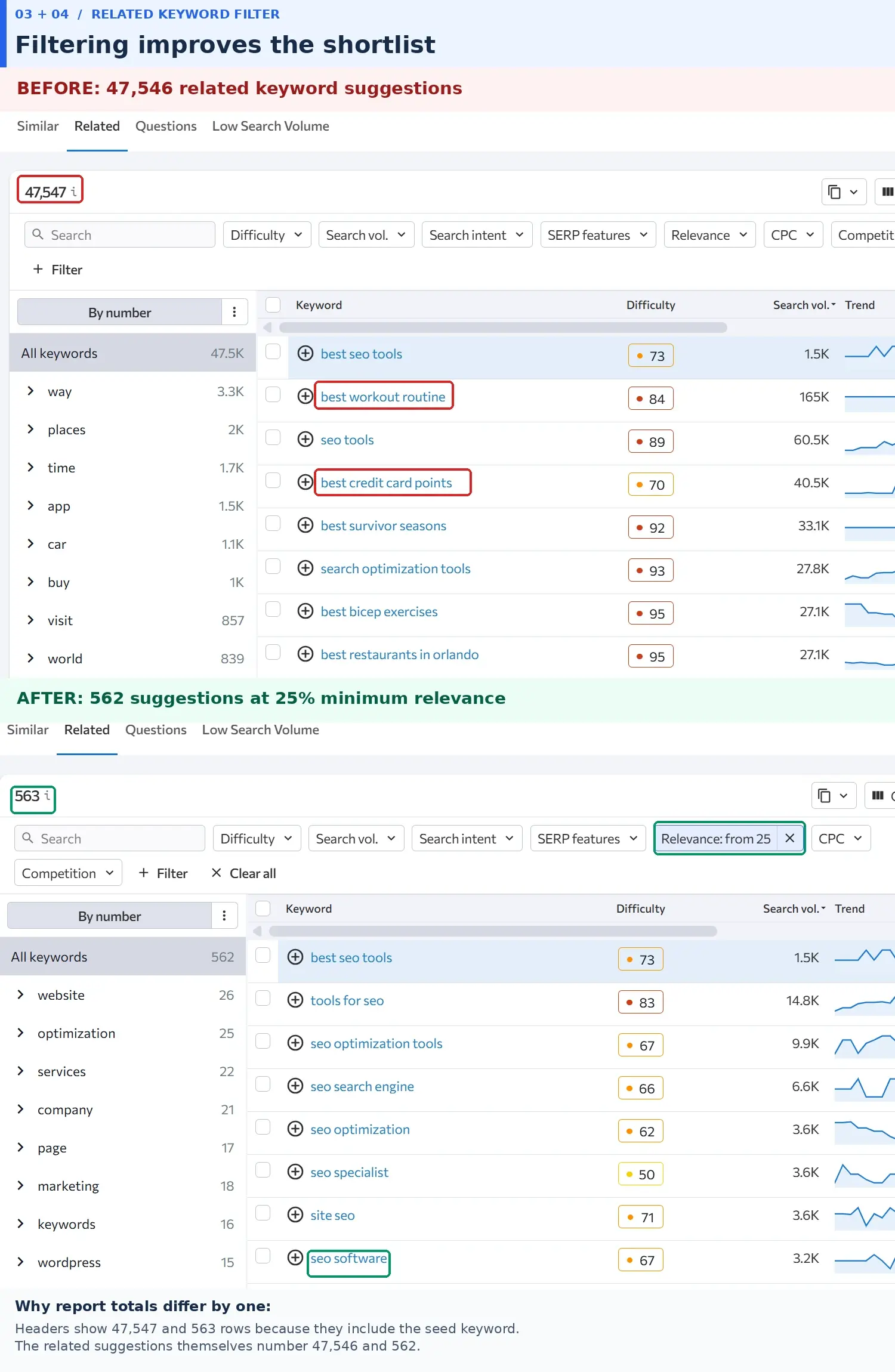
What this means: The filters are a genuine strength, but they are not optional housekeeping. Without them, the number of suggestions could give a misleading impression of the number of content opportunities. Our trial also restricted exporting certain results.
Verdict: useful for finding and screening ideas, provided you judge relevance and intent yourself. Search Volume and Keyword Difficulty are estimates, not guarantees.
4. Competitive Research: Finding Competitors and Gaps in Their Keywords
Our finding: This was one of SE Ranking’s more convincing features. It helped us identify websites competing for similar Google searches, inspect their keywords and narrow a very large list of missing keywords into potentially relevant topics.
Why do this? If another website appears for searches you want to reach, its rankings can reveal subjects you have overlooked. But a “keyword gap” is only an opportunity if that search is relevant to your audience and your website could genuinely provide a useful answer.
4.1 Step 1: Discover who competes for the same searches
We used SEMRUSH.COM as a test domain because it is a well-known SEO website with many ranking keywords. We wanted to see whether SE Ranking could identify realistic competitors.
We opened COMPETITIVE RESEARCH, entered semrush.com, chose the United States database and selected organic search analysis. Under COMPETITORS, SE Ranking found 388 competing domains, including ahrefs.com, similarweb.com, backlinko.com, neilpatel.com and clutch.co.
The report includes Domain Relevance and Common Keywords. For example, Ahrefs appeared with approximately 119,400 shared ranking keywords and a Domain Relevance figure of 17.55% in our report.
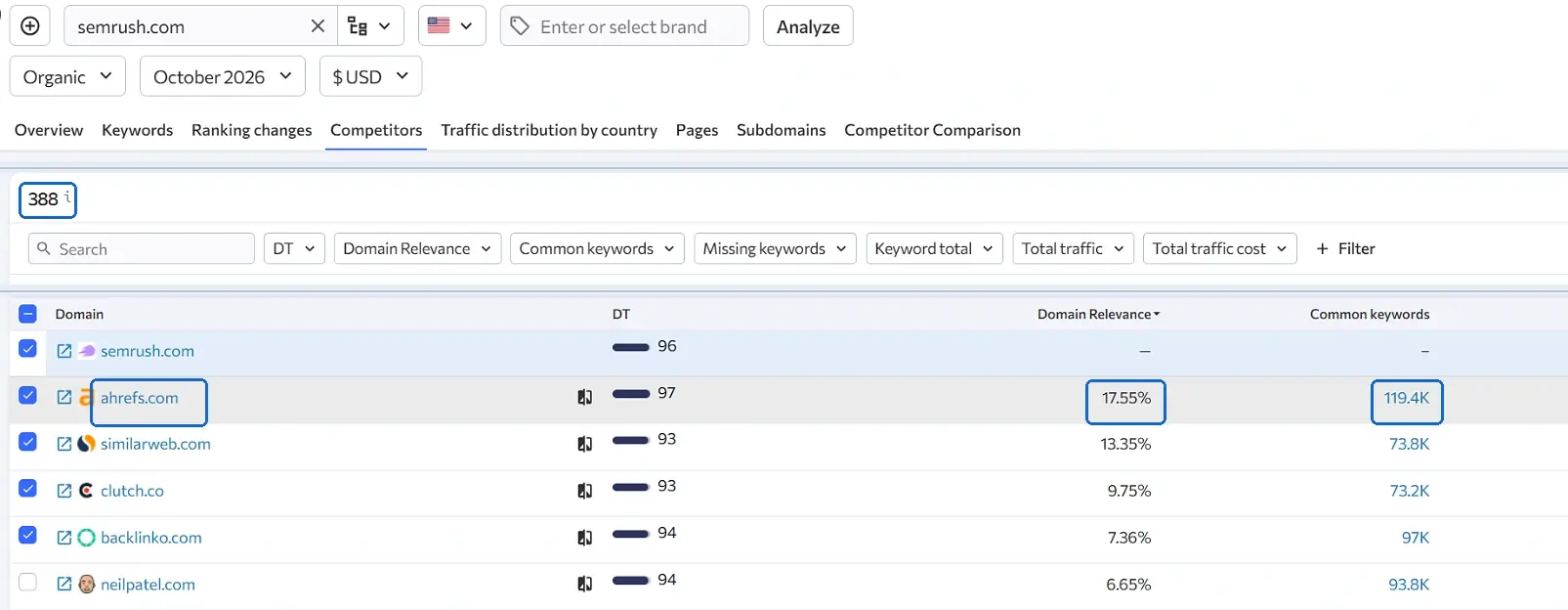
This is a useful distinction: an ORGANIC SEARCH COMPETITOR is a website that appears for some of the same Google queries. It may not sell the same product. Backlinko, for instance, publishes SEO advice but is not a direct equivalent of Semrush’s software business.
You can also research your own domain here. When we investigated testonomics.in, SE Ranking listed 68 estimated organic ranking terms, with positions, landing pages, search volumes and difficulty estimates. Unlike Rank Tracker, these are not limited to a manually selected list of tracked keywords.
4.2 Step 2: Turn a keyword gap into possible article ideas
An actionable keyword gap means more than “our competitor ranks for a term and we do not.” It means discovering a missing search topic that is relevant to our audience, has realistic ranking potential and could justify a useful page.
To test this workflow, we opened COMPETITOR COMPARISON and compared semrush.com with ahrefs.com in the US database. We treated Semrush as the reference domain: which searches did Ahrefs rank for that Semrush was missing from this report?
SE Ranking initially showed approximately 126,000 Missing keywords. This was far too broad. Queries included “ai detector” and “grammar check”, which are not automatically useful topics for an SEO software site.
We then searched within Missing keywords for “seo”. The list fell to 4,353 entries. Examples were:
- “free seo tools”: US volume 660; difficulty 11.
- “javascript seo”: US volume 590; difficulty 6.
- “real estate seo”: US volume 810; difficulty 7.
- “seo for contractors”: US volume 590; difficulty 9.
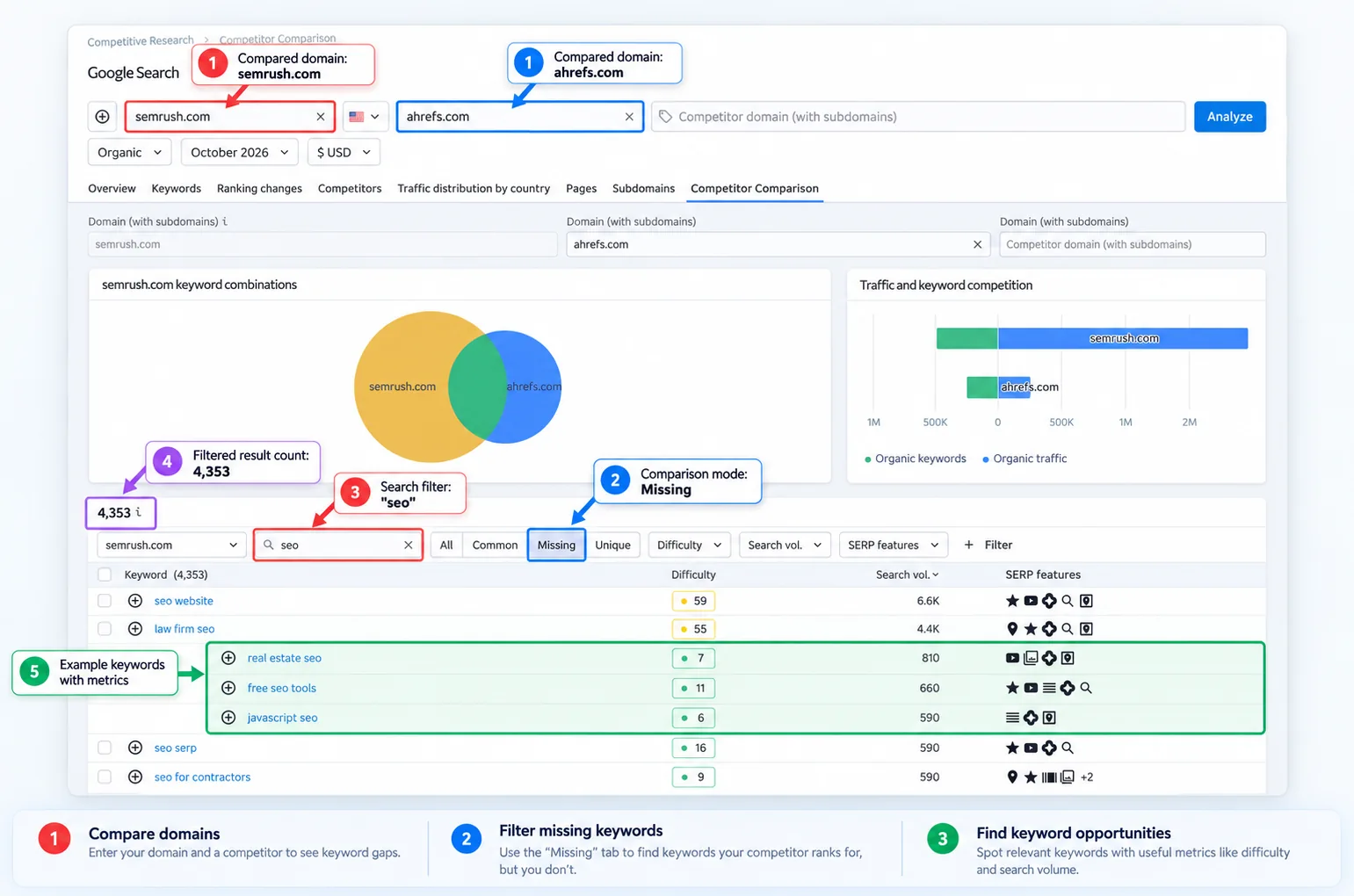
These are SE Ranking’s estimates, not verified Google search data. For an SEO publication, “javascript seo” might warrant a technical guide. “Real estate seo” might make sense only if the site plans to serve that audience. A low difficulty score alone is not enough.
What this means: SE Ranking does a useful job of finding and narrowing competitors’ keywords. Human judgment is still needed to choose subjects with the right audience, search intent and commercial purpose. Estimated competitors’ traffic and ranking coverage are not equivalent to their private Search Console data.
Verdict: strong for generating research leads; not an automatic content calendar.
5. Rank Tracker: Monitoring Google Positions Over Time
Our finding: Daily keyword reports were easy to read and helped us spot individual improvements and declines. Our short trial was not enough to verify long-term tracking accuracy.
In RANK TRACKER, first create a website project, then add the keywords you care about. Choose a search engine, country or location and device. SE Ranking tracks those combinations over time and presents positions, changes, ranking URLs and summary measures such as Average Position and Search Visibility.
We tracked 10 Testonomics keywords for Google in the India Urban setting. From October 10 to October 11, 2026:
- “RBI DEPR Exam” moved from position 7 to 6.
- “RBI DEPR Test Series” remained at position 2.
- “Indian Economic Service PYQ” remained at position 1.
- “CUET PG Economics Test Series” moved from 3 to 4.
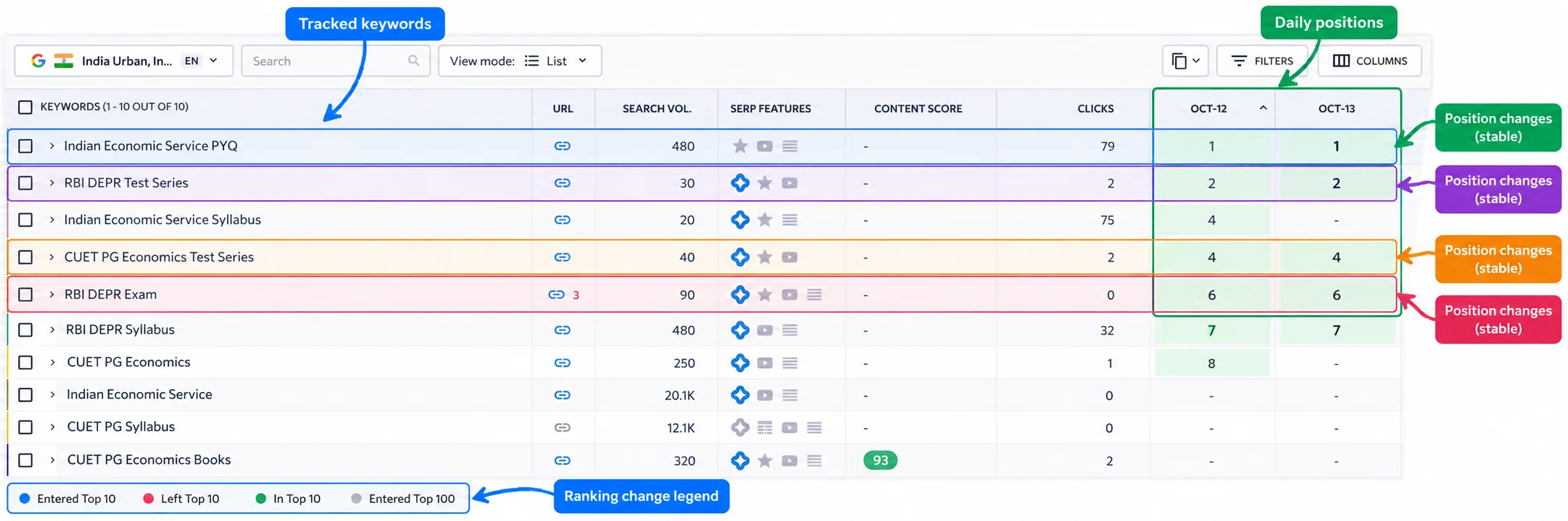
A different keyword, “CUET PG Economics”, showed a dash followed by position 9, which the interface displayed as a large gain. We would not interpret the dash as proof of a genuine 91-place improvement; we’d check subsequent dates and the exact tracking history.
The Average Position graph is helpful for an overview, but with only 10 keywords it can move substantially after a small change. Also, moving up one position for a high-value search may matter more to a business than several movements for less important terms.
Verdict: a clear daily monitoring workflow, with useful history and filters. Tracked positions depend on the chosen search conditions, while Traffic Forecast is an estimate rather than actual visits. Multiple devices and locations can consume more of a subscription’s keyword allowance.
6. SE Ranking Website Audit Review: Findings and Limitations
Our finding: SE Ranking’s Website Audit presented issues clearly and made changes between crawls easy to follow. However, an important affected-URLs view was locked during our trial, limiting our assessment of how easily users can implement fixes.
A website audit checks issues that may affect crawling, indexing or usability. Examples include broken pages, duplicate page titles and redirect problems. A good audit must go beyond counting warnings: it should explain what matters and show which pages need attention.
We audited testonomics.in. In its October 11, 2026 report, SE Ranking crawled 171 pages and showed:
- Health Score: 74/100.
- Errors: 14.
- Warnings: 290.
- Notices: 1,378.
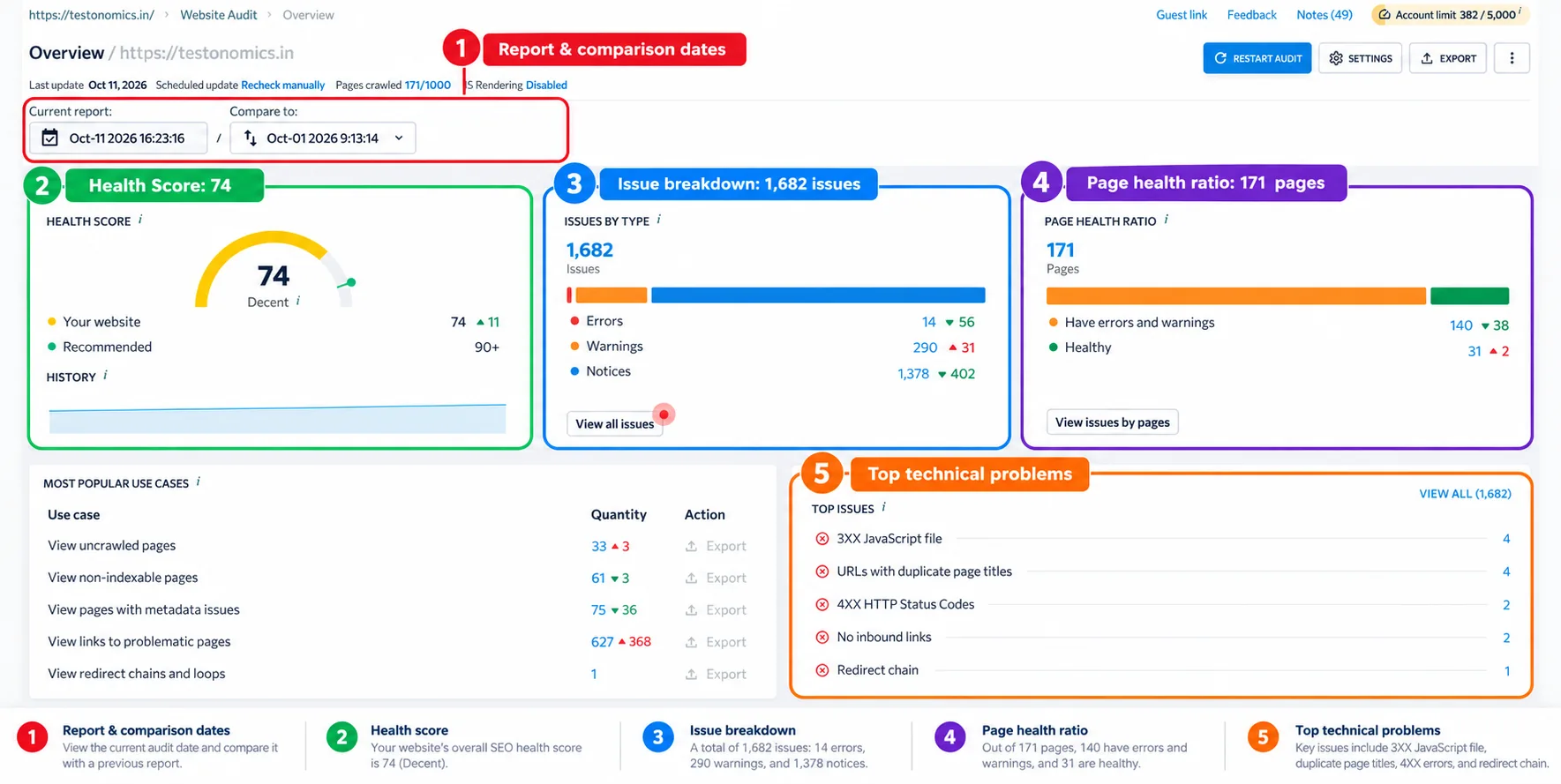
The Issue Report organized findings into categories such as Crawling & Indexing, Redirects, Meta Tags, Content and Links. Examples included four URLs flagged for duplicate page titles, two 4XX status-code instances and one redirect chain.
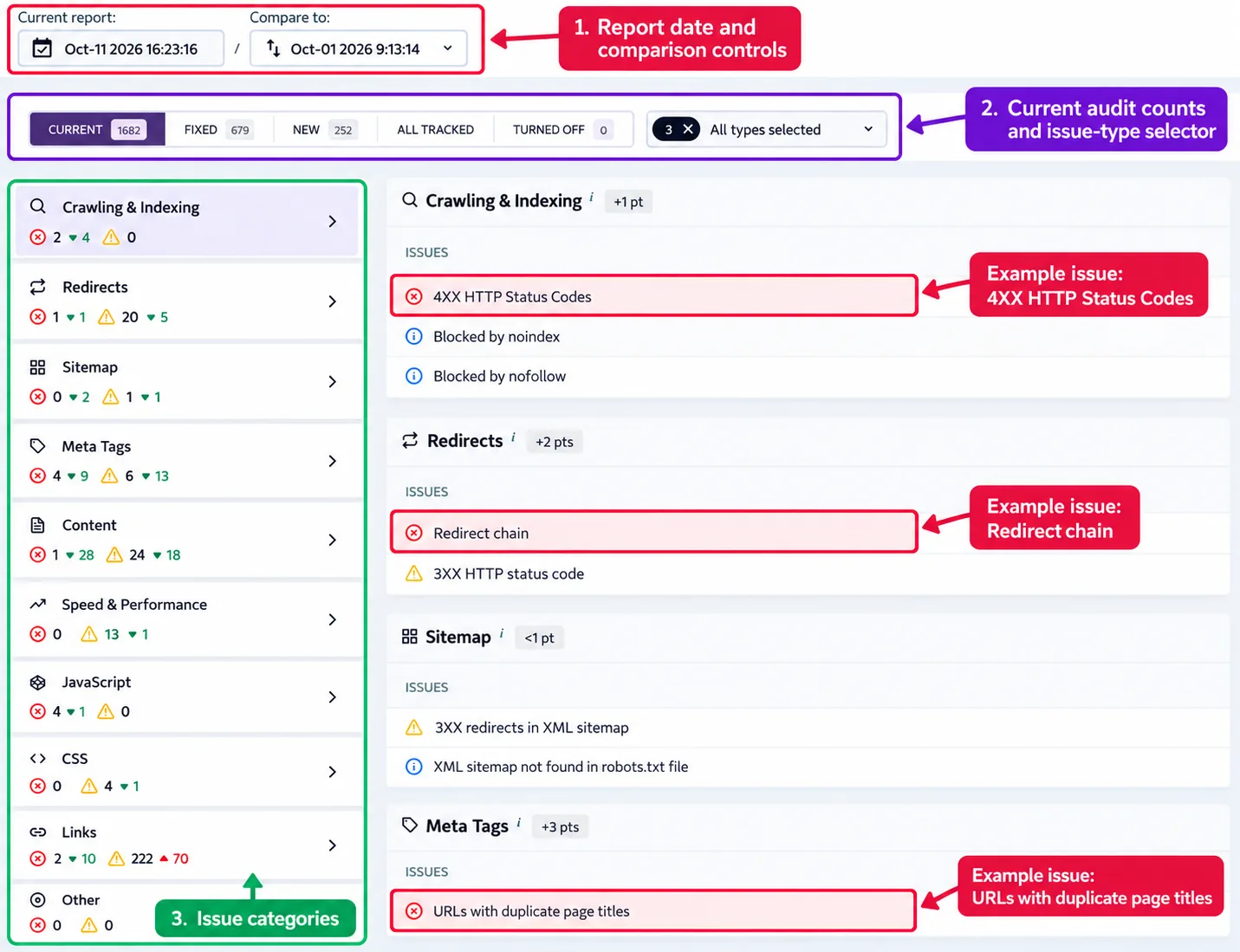
An earlier October 1 audit had shown a Health Score of 63 and 70 errors. The newer report therefore displayed an 11-point higher score and fewer errors, even though warnings and notices increased. Because Testonomics changed between the two crawls and settings may differ, we cannot attribute the improvement solely to any one action or treat the scores as objective Google ratings.
We opened the duplicate-title issue to understand exactly which pages were affected. SE Ranking explained the issue, but the detailed affected-URL list in our trial showed “Available by subscription”. That restricted our ability to assess its page-level fixing workflow. And whether a duplicated title matters depends on the affected pages; a deliberately noindexed archive may not deserve the same priority as an important landing page.
Our latest crawl had JavaScript rendering disabled, with a limit of 1,000 pages per audit. It should not be mistaken for a complete test of every way the site might render.
| Assessment | Evidence from our audit | Practical consequence |
|---|---|---|
| Useful: issue organisation | The report grouped crawling, indexing, redirects, metadata, content and links, including duplicate titles and 4XX responses. | It helped us identify categories to investigate before deciding which fixes mattered. |
| Useful: crawl comparisons | The October 1 and October 11 reports showed changes in scores and issue counts. | Useful for monitoring changes, but different settings or site changes can affect comparisons. |
| Trial limitation: affected URLs | The duplicate-title detail showed “Available by subscription”. | We could not fully assess the workflow from an issue summary to fixing the affected pages. This is not evidence that the paid product lacks that workflow. |
| Testing limit: rendering | JavaScript rendering was disabled in our latest crawl. | Our results do not establish how completely it audits content that depends on JavaScript. |
Verdict: SE Ranking Website Audit was useful for organising issues and comparing crawls. Our trial did not establish how effective the full page-level remediation workflow is. Before subscribing primarily for audits, confirm access to affected-URL reports and test the crawl settings your website needs.
7. Backlink Checker: Understanding Links to Your Site
Our finding: SE Ranking showed backlinks and lost referring domains in a convenient format. Its metrics helped identify what to investigate, but a high trust score alone did not establish that a link was valuable.
A BACKLINK is a link from another website to yours. A REFERRING DOMAIN is the website supplying one or more backlinks. SE Ranking’s Backlink Checker can analyze your site or a competitor’s, showing referring domains, backlinks, anchors, new/lost links and proprietary Domain Trust or Page Trust measures.
For testonomics.in, our October 9 report showed:
- Domain Trust: 16/100; Page Trust: 5/100.
- Referring domains: 116; backlinks: 232.
- In the previous 30 days: five new and 22 lost referring domains; nine new and 23 lost backlinks.
- Six broken backlinks were also reported.
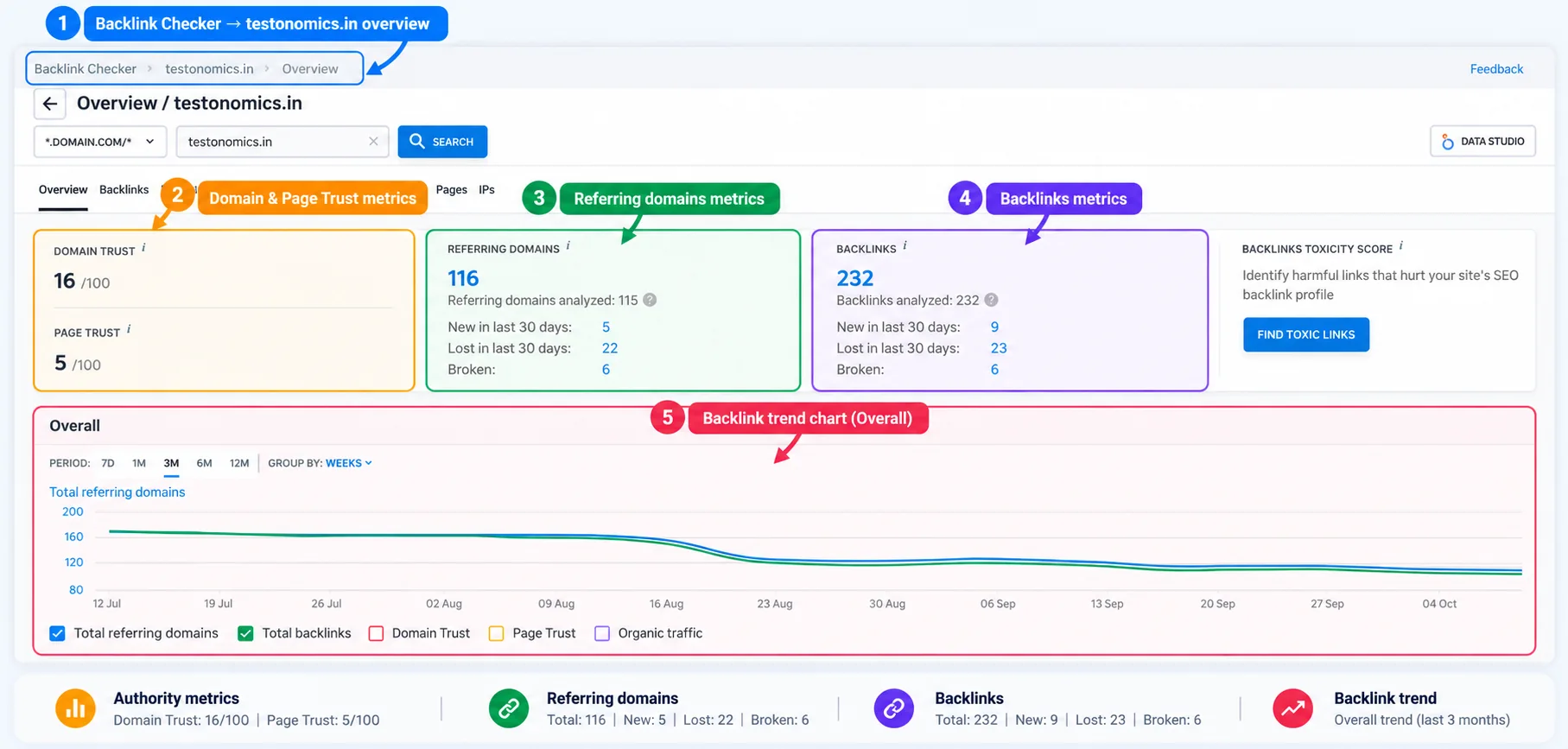
Some recently lost referring domains had unusual subdomain names, little displayed traffic and relatively high Domain Trust scores, often in the 70s. We did not inspect every source, so it would be wrong to label these as spam simply from their names or score patterns.
The practical lesson is that a link from a relevant, credible industry publication may be more useful than a high-scoring link from an unrelated website. Domain Trust is SE Ranking’s proprietary measure, not a Google score. Do not disavow backlinks merely because software flags them as suspicious.
Separate Backlink Monitor and Backlink Gap Analyzer features are available, but we did not comprehensively test those workflows or independently compare SE Ranking’s entire backlink database with rivals.
Verdict: helpful for tracking changes and prioritizing manual inspection; link quality still requires context.
8. AI Search Visibility: Does ChatGPT Mention Your Brand?
Our finding: AI Results Tracker made it possible to check where a brand appeared in recorded AI-generated answers and read the answers behind its scores. Our experiment was deliberately small, so it does not establish long-term visibility.
Why this matters: someone researching a product may now ask ChatGPT or another AI service for recommendations rather than begin with a traditional search. A relevant brand mention or link could increase awareness or referrals, although an AI mention is not an established direct Google ranking factor.
SE Ranking’s AI Results Tracker monitors selected prompts on supported AI services. Its reports distinguish MENTION PRESENCE (the brand’s name appears) from LINK PRESENCE (a link to the brand’s website appears). Competitors and Sources reports help explain who else is visible and which websites AI responses cite.
We configured three commercially relevant ChatGPT prompts for Testonomics on October 11:
- “Best RBI DEPR coaching in India”: Testonomics was not mentioned.
- “Best RBI DEPR test series”: Testonomics was mentioned.
- “Best CUET PG Economics mock tests”: Testonomics was not mentioned.
The dashboard therefore showed Mention Presence of 33.33% (one out of three prompts) and Link Presence of 0%. This is a calculation for OUR THREE TEST PROMPTS, not a market-wide visibility estimate.
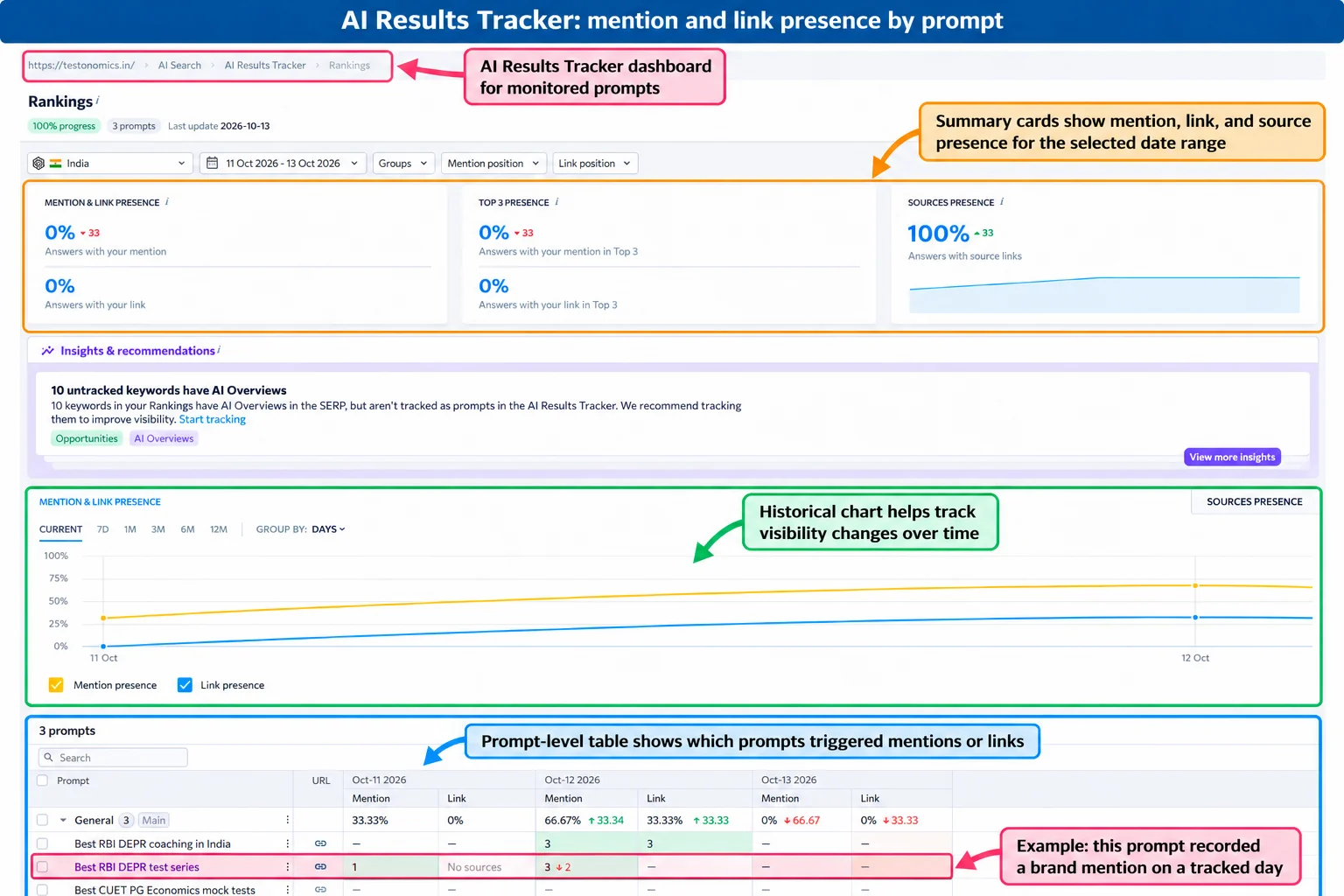
Daily results can change: the updated screenshot covers October 11–13. Its prompt-level table shows 33.33% mention presence on October 11, 66.67% on October 12, and 0% on October 13. The October 13 summary also shows 100% Sources Presence, which reflects source links in the AI answers rather than links to our brand. These later readings do not invalidate the original October 11 observation.
We opened the recorded answer to “Best RBI DEPR test series” and verified that it listed Testonomics first in a shortlist. In the broader RBI coaching response, other brands including Bliss Point Studies and ixamBee appeared instead. This ability to open the underlying answer is important: it lets us verify whether the platform’s extracted mention is meaningful.
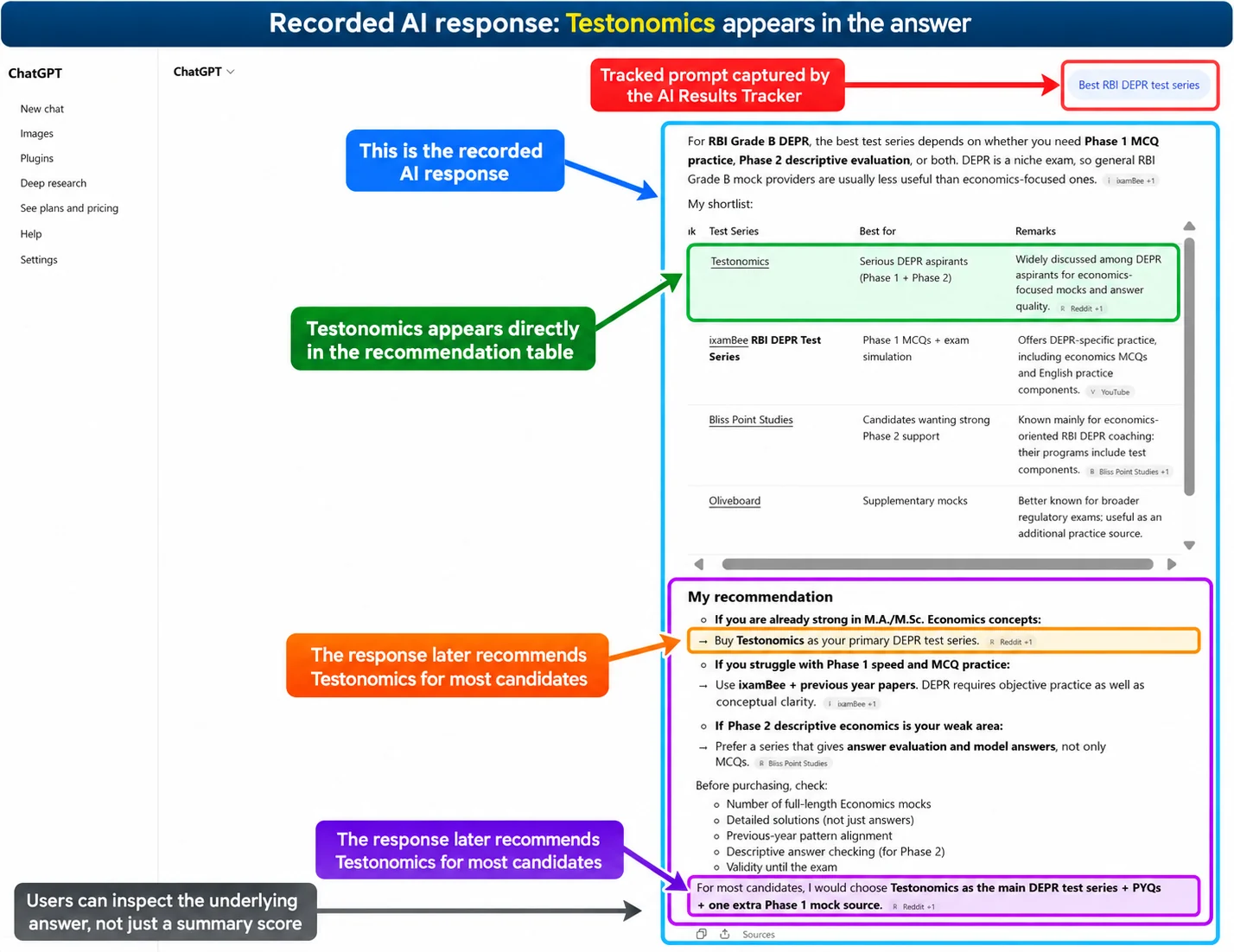
A recorded answer can cite third-party source websites without linking to the monitored brand. That is consistent with a 0% Link Presence score for our site, not necessarily an error.
Verdict: promising for observing brand mentions and the surrounding evidence. Its usefulness depends on sensible prompt selection and repeated measurements. We did not test enough prompts, dates or AI platforms to judge reliability at scale.
9. Content Editor and AI Writer: Helpful Guidance or Mechanical Scoring?
Our finding: Content Editor provided useful competitor research and content-planning suggestions, but some recommendations would have made our article longer without a clear benefit to readers. The trial did not let us test full AI article writing.
CONTENT EDITOR lets you optimize existing content or prepare a new brief for a target keyword. It compares selected competing pages and suggests topics, headings, terms, metadata and content parameters. Users should review the competing pages first: they are the benchmark against which the proposed changes are calculated.
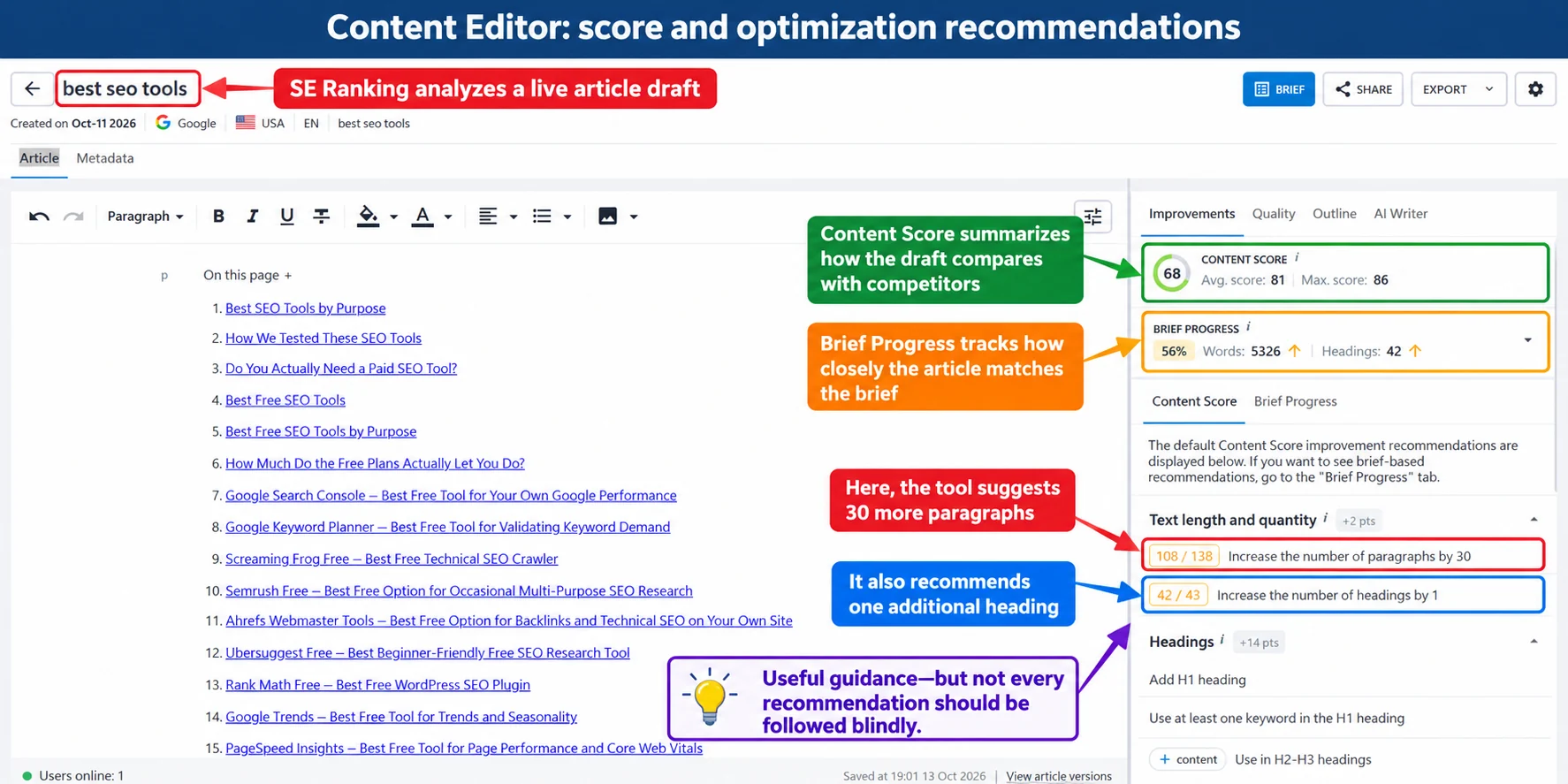
We entered the published Toolquo article “Best SEO Tools” and selected the US keyword “best seo tools”. SE Ranking reported a Content Score of 68, compared with a competitor average of 81 and top score of 86. It found 5,326 words, 42 headings and 14 images, with 56% Brief Progress.
Some checks were worth reviewing, including the main heading, metadata and relevant terms. But it also suggested adding about 30 paragraphs and 17 images. There was no evidence that adding all that material would improve understanding; it could instead make the article bloated and slower.
We also created a brief for “SE Ranking Review”. SE Ranking’s automatic competitor choices included some unrelated pages about rankings in other subjects. We removed those. Its Heading Structure suggestions occasionally contained page furniture such as author names or “Leave a Reply”.
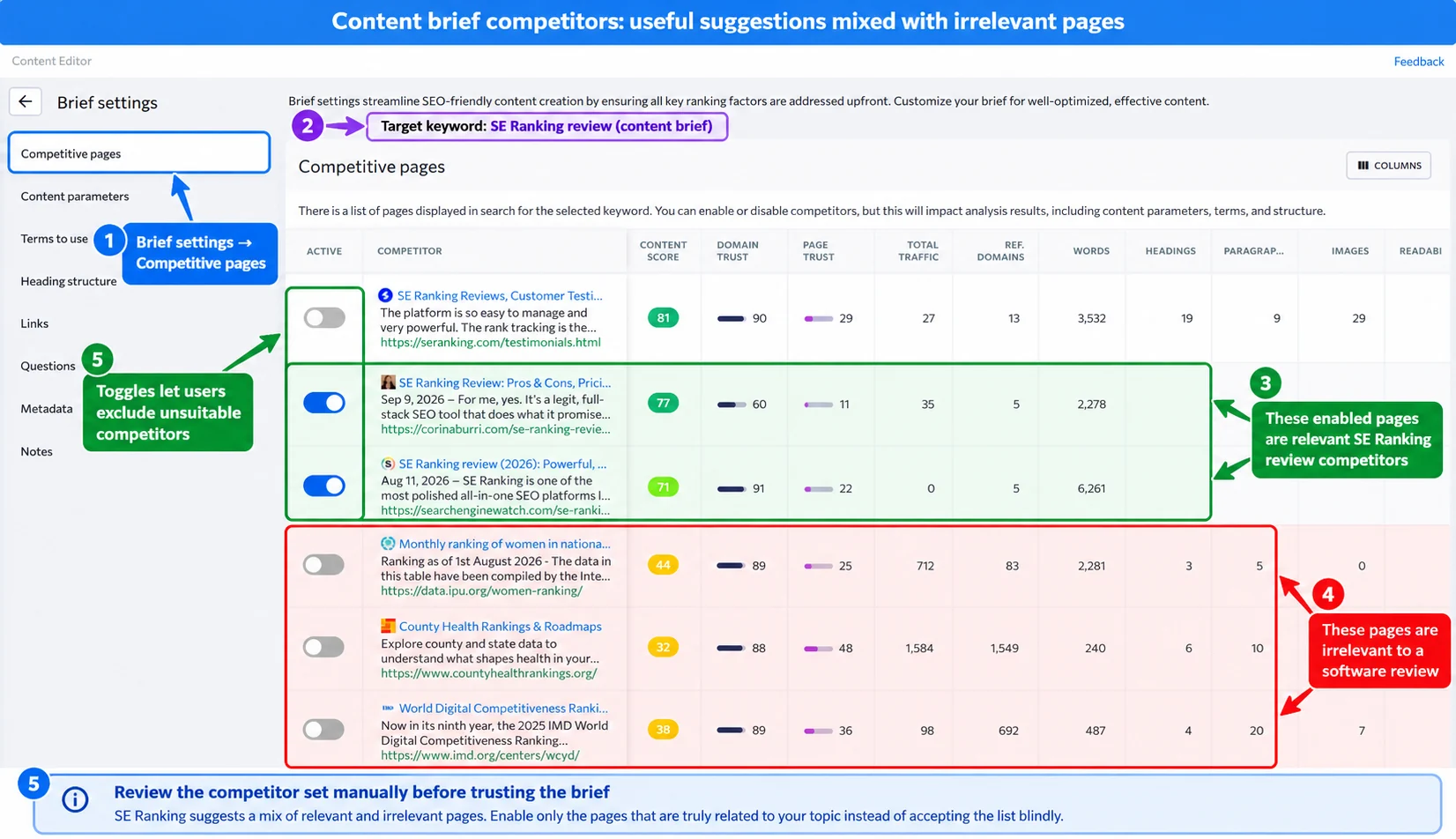
For this review, its Content Parameters suggested roughly 2,278–3,417 words and 13–20 images. Those may be useful comparison signals, but we would never add images simply to reach a tool-defined target. The Links area also showed links used by competitors, including commercial links, which are not automatically authoritative sources or backlink opportunities.
Under AI Writer, we saw ten headline suggestions, some generic. “Generate Step by Step” and “Generate in One Click” both required an upgrade from our trial. We cannot honestly evaluate the quality of a full AI-generated article.
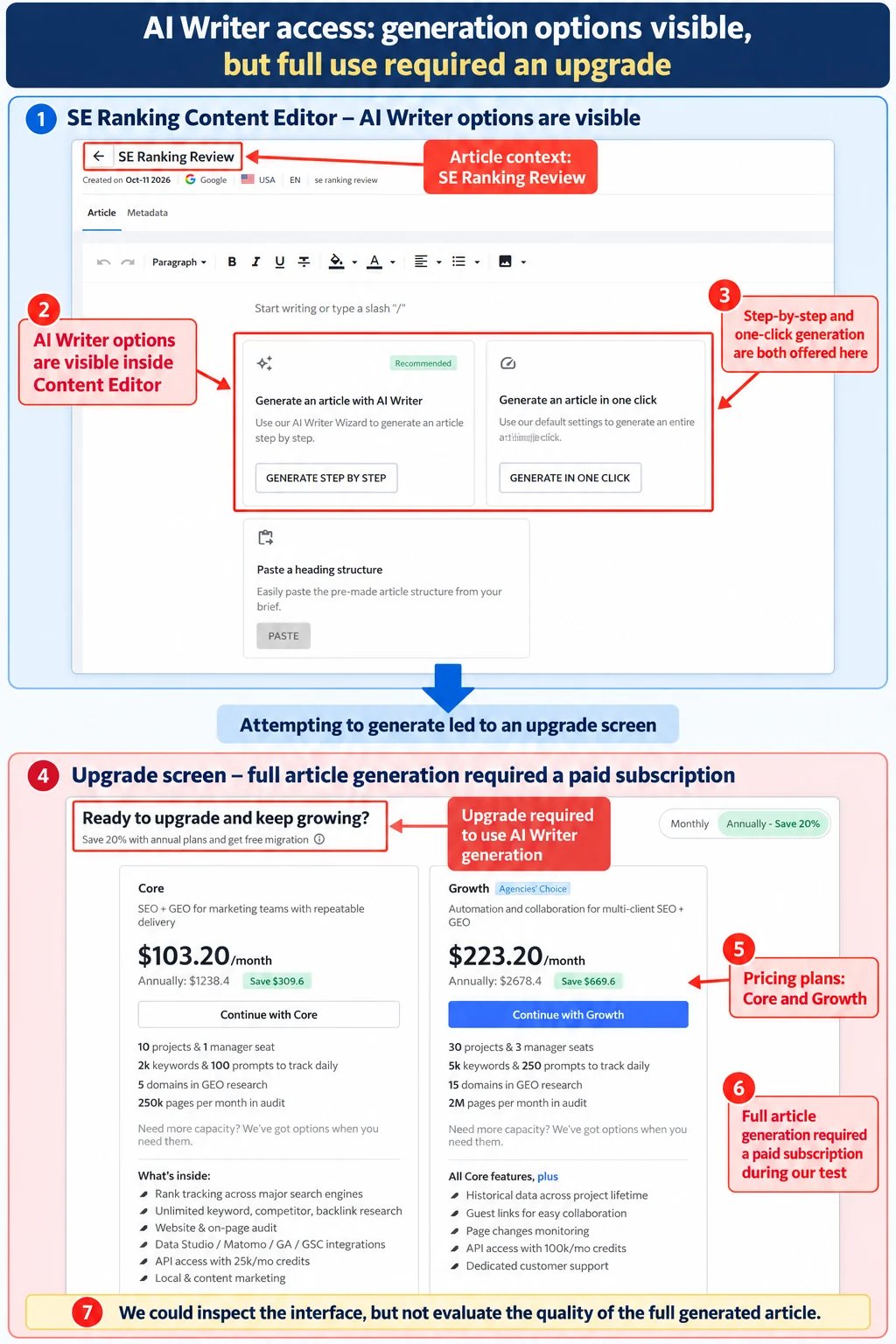
Verdict: useful as an editorial assistant, not an editorial authority. Human judgment about accuracy, structure, originality and reader value matters more than maximizing a Content Score.
10. Ease of Use, Reports and Integrations
Our finding: SE Ranking was generally easy to navigate after the initial orientation. Its bigger learning curve is understanding what the reports mean, especially when two similarly named measures come from different workflows.
The menus, dashboards and filters were reasonably clear in our tests. Rank Tracker and Website Audit were especially straightforward. Users still need to distinguish estimated competitor traffic from actual analytics, and proprietary Domain Trust from any official Google assessment.
SE Ranking advertises Report Builder, templates, report sharing or scheduling, and integrations including Google Search Console, Google Analytics and Looker Studio. Some client-facing or white-label capabilities vary by subscription or add-on.
We did not generate and schedule a complete client report, so reporting reliability and agency collaboration are not part of our firsthand verdict.
11. SE Ranking Pricing, Plans and Free Trial
Our finding: The platform has substantial functionality, but subscription value depends on how many websites, keywords, users and audits you genuinely need. Check live pricing before buying, because costs and allowances change.
At our October 2026 check, Core started at $129 per month, while Growth started at $279 per month; annual billing reduced the monthly equivalent. Enterprise pricing was custom. These are historical reference prices, not a promise about today’s rate.
Core advertised 10 projects, 2,000 daily tracked keywords, 250,000 audit pages per month and 100 AI prompts daily. Growth expanded these allowances and added team capacity. Keyword tracking across different locations, devices and search engines can consume more allowance than the number of unique keyword phrases suggests.
Certain agency, API and expanded AI-monitoring functions may cost extra. Rather than reproduce an easily outdated pricing table, we recommend checking the current plan comparison for what is included.
The 14-day free trial did not require a credit card at signup. Our attempt to register using an ordinary Gmail address was rejected; the form requested an eligible work or business email. Trial access also limited some exports, detailed Website Audit reports and full AI article generation. These trial restrictions should not be confused with the capabilities of paid plans.
Check current prices: SE Ranking official pricing and plans. Details may change.
12. SE Ranking vs Semrush: What We Can Say So Far
SE Ranking and Semrush overlap in keyword research, competitor analysis, rank tracking, site audits and backlinks. We have used both, but we have not yet compared them under a complete identical set of tests. It would therefore be premature to declare one more accurate, comprehensive or cost-effective.
SE Ranking’s filters and daily ranking reports performed well in our trial, but related-keyword suggestions required substantial cleaning. Different plans also have different tracked-keyword capacities and extra feature costs. Neither a lower headline price nor a larger keyword database automatically identifies the better purchase.
We will expand this comparison after more controlled testing. For now, choose on the basis of the workflows and allowances you need rather than a speculative winner.
13. SE Ranking Pros and Cons
What We Liked
- Research, tracking and audits available together.
- Useful organic competitor discovery and keyword-gap filters.
- Clear daily tracked-keyword reports.
- Well-organized audit issues and crawl comparisons.
- Convenient referring-domain and lost-link investigation.
- AI brand-mention reports with inspectable recorded responses.
What Could Be Better
- Broad Related Keywords results needed extensive filtering.
- Estimates and proprietary scores can be mistaken for facts.
- Content suggestions sometimes encouraged unnecessary additions.
- Paid subscriptions may not suit small, early-stage websites.
- Trial restrictions limited access to some detailed reports and AI writing.
- Long-term data accuracy and advanced agency workflows remain untested by us.
14. Who Should Use SE Ranking?
NEW BLOGGERS: Start with free tools if you have only a small number of pages and are still learning SEO. A subscription becomes more compelling when recurring research and monitoring create a real need.
ESTABLISHED WEBSITE OWNERS: Consider Core if keyword research, ranking history, competitor monitoring and technical auditing feature in your regular workflow.
FREELANCERS: Potentially a strong fit when managing multiple clients, provided project, user and tracked-keyword allowances are sufficient.
AGENCIES: Assess Growth, client reporting, seat limits and any Agency Pack costs together. We did not fully test white-label reporting or large-team administration.
A software subscription does not automatically improve search rankings. Its value comes from how effectively you interpret the reports and make changes.
15. Final Verdict: Should You Try SE Ranking?
SE Ranking is a credible SEO platform for people who regularly research search opportunities, analyze competitors, track keyword rankings and maintain websites. We found particular value in the competitor analysis workflow and the clarity of daily tracking. AI Results Tracker also provided a useful way to inspect brand mentions in recorded AI answers.
The most important qualifications are equally practical: default suggestions are not all relevant; estimates are not ground truth; and content scores cannot replace human editorial judgment. The trial left several paid workflows incompletely tested.
Our recommendation: shortlist SE Ranking if you need several of its tools frequently. During the trial, research a real topic, track your own important keywords and audit your actual site. Then compare the total subscription cost with the time and insight you expect to gain.
Compare SE Ranking’s current plans and allowances. Pricing and offers can change.
16. Frequently Asked Questions
16.1 Is SE Ranking worth paying for?
It can be for site owners or professionals who regularly use keyword research, rank tracking, competitor analysis and audits. For a newly launched website, free tools may be enough initially.
16.2 Does SE Ranking have a free version?
It offers a 14-day trial rather than a permanently free full platform. Trial limits apply, and our registration required an eligible work email.
16.3 Is SE Ranking a good alternative to Semrush?
Yes, the main SEO workflows overlap. We have not conducted sufficient matched testing to claim one provides more accurate data or better overall value.
16.4 How accurate is SE Ranking?
Its estimates of organic traffic, search volumes, Keyword Difficulty and Domain Trust come from its own databases and methods. Rank Tracker reports rankings under selected search conditions. We did not independently benchmark every estimate or its long-term accuracy.
16.5 Will SE Ranking improve my Google rankings automatically?
No. It can help identify technical issues, relevant search terms and ranking changes, but results depend on the quality and execution of your SEO work.
16.6 Can SE Ranking track ChatGPT mentions?
Yes. AI Results Tracker monitors selected prompts and whether a brand is mentioned or linked. Our short ChatGPT test verified one mention but does not establish wider reliability.
16.7 Can I research a competitor without its website login?
Yes. Competitive Research and Backlink Checker analyze public domains using SE Ranking’s databases, rather than accessing a competitor’s private Google Search Console account.
16.8 Is SE Ranking suitable for beginners?
The interface is approachable, but it helps to understand keyword intent, backlinks, estimated traffic and technical SEO first.
17. How We Tested SE Ranking
We used SE Ranking’s trial in October 2026. Our observations come primarily from these websites: testonomics.in (rank tracking, audits, backlinks and AI brand mentions); toolquo.com (Content Editor); and public domains semrush.com and ahrefs.com (competitor research).
Tests Performed
- Keyword Research: “best seo tools”, United States; metrics, suggestions and relevance filters.
- Competitive Research: semrush.com, United States; 388 organic competitors and estimated ranking keywords.
- Competitor Comparison: semrush.com versus ahrefs.com; initial missing-keyword list and “seo” filter.
- Rank Tracker: ten Testonomics keywords, Google India Urban; October 10–11 daily changes.
- Website Audit: Testonomics crawls dated October 1 and 11; latest 171 pages with JavaScript rendering disabled.
- Backlink Checker: Testonomics October 9 backlink and lost-referring-domain reports.
- AI Results Tracker: three ChatGPT prompts tracked on October 11; mention/link presence and recorded answers.
- Content Editor: published Toolquo “Best SEO Tools” article; new SE Ranking Review brief.
- AI Writer: headline suggestions tested; full-article generation locked in trial.
What We Did Not Establish
- Comparative accuracy of search volumes, backlinks or tracked rankings across competing tools.
- Reliability of AI mention detection across many prompts, countries, platforms or dates.
- Full client reporting, white-label agency use, advanced APIs or paid AI article generation.
- A causal relationship between the changing Testonomics audit scores and any particular site improvement.
We evaluate the usefulness of the outputs we could inspect rather than awarding points for the quantity of data shown. Trial-restricted features are identified as such, not described as absent from the paid product.
Testing disclosure: This review separates our firsthand testing from features described in SE Ranking’s documentation.
About the author
Nikhil Bhardwaj
Founder & Editor, Toolquo
Nikhil leads Toolquo’s editorial direction, focusing on practical software research, transparent comparisons, and clear buying decisions.
View author profile →Keep exploring
Related guides
November 3, 2026
Yoast SEO Sitemap: How to Find, Configure and Fix Errors (2027)
Find your Yoast SEO sitemap, choose which URLs belong in it, submit it to Google Search…
November 1, 2026
How to Use Yoast SEO: Complete Beginner’s Guide (2027)
Learn how to install and configure Yoast SEO, choose WordPress SEO settings, optimize a post, and…
October 29, 2026
Yoast SEO Review (2027): How Good Is It, and Is Premium Worth It?
Our hands-on Yoast SEO review explores Free features, Premium pricing, strengths, limitations, and whether upgrading is…