Rank Math SEO Score Explained: What Is a Good Score and How to Improve It?
Understand what your Rank Math SEO score means, which checklist recommendations matter, and how to improve content without chasing 100/100.
On this page
You open an article in WordPress and notice a colored Rank Math score: perhaps 48, 75, 87 or even 100. What is it telling you? Should you change the article until you get a higher number?
The most important thing to understand is this: the goal is to publish an accurate, clear, useful article that answers the reader’s question. Rank Math provides a checklist to help you notice things you may have missed. It does not read your article like a knowledgeable editor, fact-check your claims, or decide whether your explanation is genuinely good.
For example, Rank Math can identify that you have not used your selected focus phrase in a heading. It cannot reliably tell whether you have explained a complicated concept correctly, addressed the reader’s actual confusion, or chosen a misleading example. Adding the phrase to a heading may increase the score without improving the article at all.
That is why we recommend treating the Rank Math SEO score as a prompt to review your work, not a target to chase blindly. In this guide, we explain what the number means, how to inspect the checklist, which recommendations deserve attention, and how to measure results beyond the plugin. We also share two experiments from Toolquo and Testonomics that make these limits particularly clear.
1. What Does a Rank Math SEO Score Actually Measure?
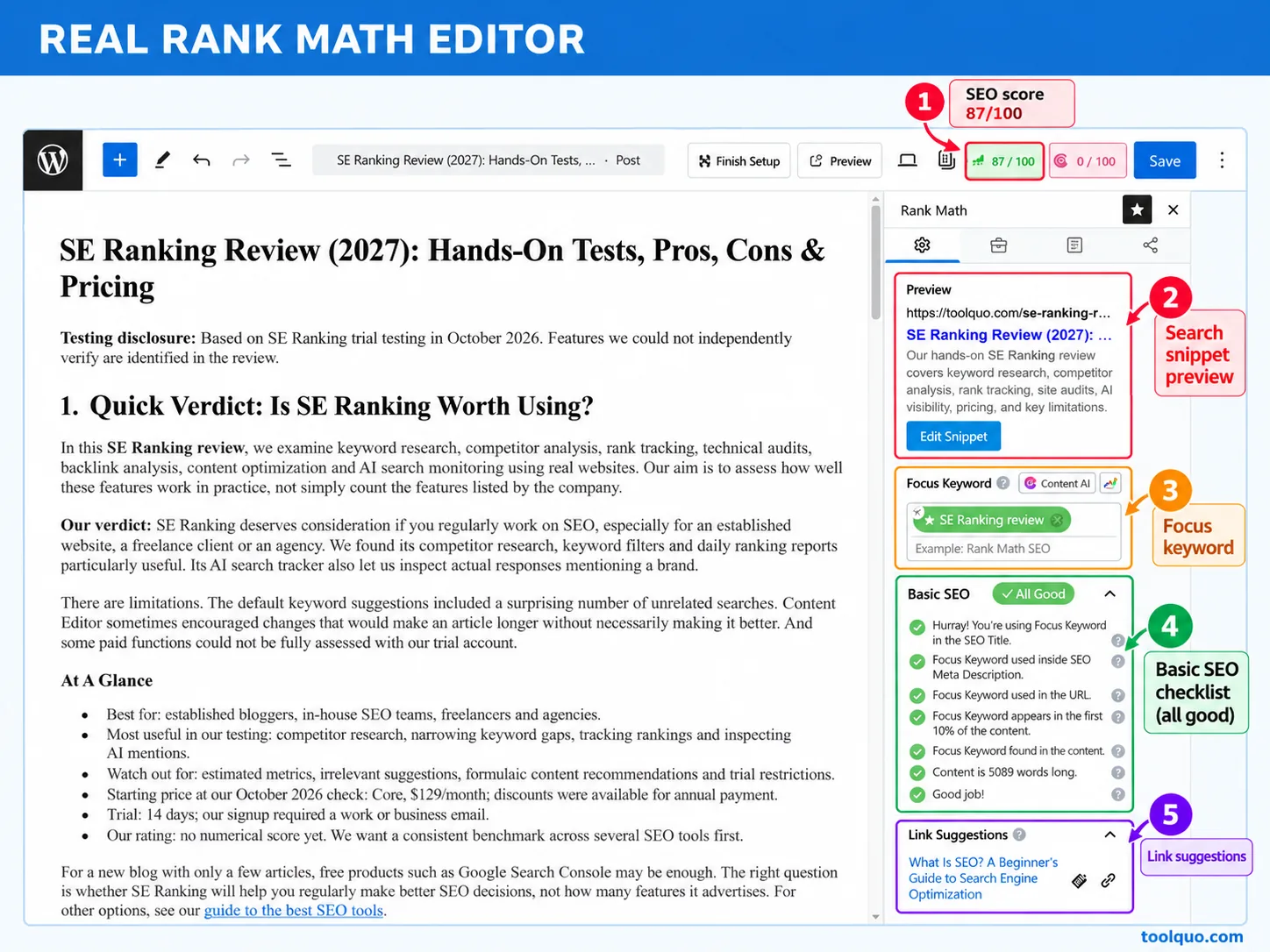
Rank Math is an SEO plugin for WordPress. When you edit a page, it reviews selected features of the page and produces a score out of 100. Its on-page checklist is organized into groups such as Basic SEO, Additional SEO, Title Readability and Content Readability.
Yoast communicates its assessment through traffic lights instead of a prominent number out of 100. Our Yoast SEO score guide explains those indicators and shows why an overall green result can still include an orange recommendation. The two plugins use different checks, so their ratings are not directly interchangeable.
Examples of what it can check include whether a focus keyword appears in the title, whether you have entered a description, whether the page contains subheadings, and whether it finds internal links. These are observable features. They are not the same as the overall quality of the page.
Consider two articles answering “Why do bond yields rise?” Article A repeats the main keyword, includes a list of headings, and satisfies many automated checks, but never explains how inflation expectations affect the price investors are willing to pay for an existing bond. Article B explains the price-yield relationship clearly with a worked example but misses a few checklist items. Article A could have the higher plugin score while Article B is far more useful to a beginner. This is an illustration, not a ranking experiment.
Here is the practical order: first, write an article that answers the reader’s question accurately and clearly. Next, open Rank Math and use its checklist to catch things you may have overlooked, such as an uninformative title or a missing description. Finally, use your judgment: make each suggested change only when it improves the page. A green checklist cannot replace a careful editorial review.
1.1 How does Rank Math work out the score?
Rank Math runs a series of rule-based checks. Some refer to the primary focus keyword you enter, some can consider additional focus keywords, and others look at elements such as readability and links. The plugin awards points according to its scoring logic and summarizes the result.
You do not need to calculate the points yourself. What matters is knowing what each failed check refers to. Nor should you assume that every red item costs the same number of points or that six extra points mean a six-percent improvement in content quality.
A focus keyword is a phrase you select to describe the query or topic you want the page to address. Entering it gives Rank Math a reference for its checks. It does not send an instruction to Google to rank the page for that phrase. If you change the phrase, Rank Math may reconsider several checks and change the score, even though your article remains identical.
Official explanation: https://rankmath.com/kb/score-100-in-tests/
1.2 Does Google consider the Rank Math score?
No. Google does not use the number displayed by Rank Math as a ranking factor. Google does not need to see your WordPress editor score to evaluate a publicly accessible page.
Some underlying improvements can nevertheless be useful. A descriptive title helps communicate the subject. A link to a related explanation helps visitors find it and may help search engines discover it. A faster, accessible page may work better for users. Those benefits come from the improvements themselves, not from the points they happen to earn in Rank Math.
Conversely, inserting extra exact-match keywords simply to turn a warning green could make a page harder to read. In that case, a higher score can coexist with a worse article.
2. What Is a Good Rank Math SEO Score?
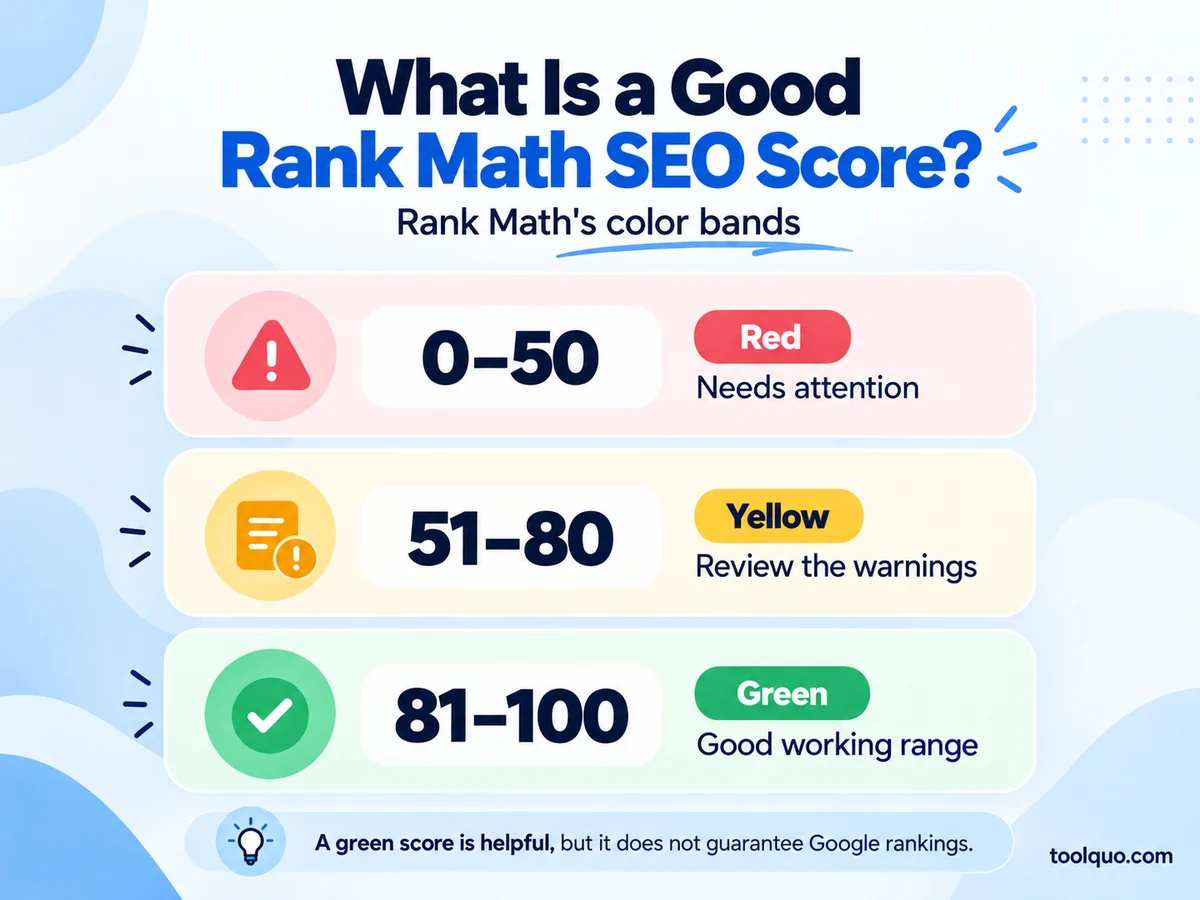
For individual posts and pages, Rank Math uses three color ranges: below 51 is red, 51 to 80 is yellow, and 81 to 100 is green. These are the plugin’s own checklist bands, not Google quality grades.
0–50 (red): Review the setup and the underlying article. There may be missing metadata, missing focus keyword information or other easily corrected omissions.
51–80 (yellow): Examine the warnings. Fix meaningful problems, but do not assume every flagged item needs action.
81–100 (green): Many checks have passed. Look at the remaining warnings and decide whether addressing them would actually help the page.
Toolquo’s practical rule is to regard 81+ as a convenient initial target, not as a condition of publication. An article scoring 78 with an excellent explanation is not automatically inferior to one scoring 95. We would publish the stronger article rather than compromise its quality to increase the number.
2.1 Should you aim for 90 or 100?
A score of 90 means that many of Rank Math’s applicable checks have passed. A score of 100 means all the applicable scoring checks have passed. Neither number certifies that the article is the best answer on the internet. A plugin cannot verify that a factual claim is correct, that a difficult concept is explained in a way beginners understand, or that the information is sufficiently original.
Consider a post titled “Why Do Government Bond Yields Rise?” Suppose Rank Math suggests adding a number to the headline. Changing it to “7 Reasons Government Bond Yields Rise” makes sense only if the article genuinely explains seven well-chosen reasons. If the article is mainly about the mechanism connecting bond prices and yields, the numbered headline may actually make its promise less accurate. Even if the plugin rewards the number, the writer should keep the more accurate title.
Another example: a post explaining Rank Math might score higher if the phrase “rank math seo score” appears in several more headings. But headings like “Rank Math SEO Score Benefits,” “Rank Math SEO Score Examples” and “Rank Math SEO Score Conclusion” can sound repetitive. A clear heading such as “Why the Score Changed Without Editing the Article” helps the reader more. The sensible stopping rule is: once genuine problems are fixed, do not rewrite good content purely for extra points.
3. Rank Math SEO Scoring Components Explained, With Examples
Open a post in the WordPress editor and select its Rank Math score to display the analysis. The plugin groups recommendations under Basic SEO, Additional SEO, Title Readability and Content Readability. These are categories of checks used to calculate Rank Math’s own score. They are not four Google ranking components or a complete test of whether your article is good.
For each warning, ask three questions: What is the plugin checking? What would this change actually improve for the reader or search engine? Is its suggestion appropriate for this particular page?
3.1 Basic SEO: Focus Keyword, SEO Title, Description, URL and Main Content
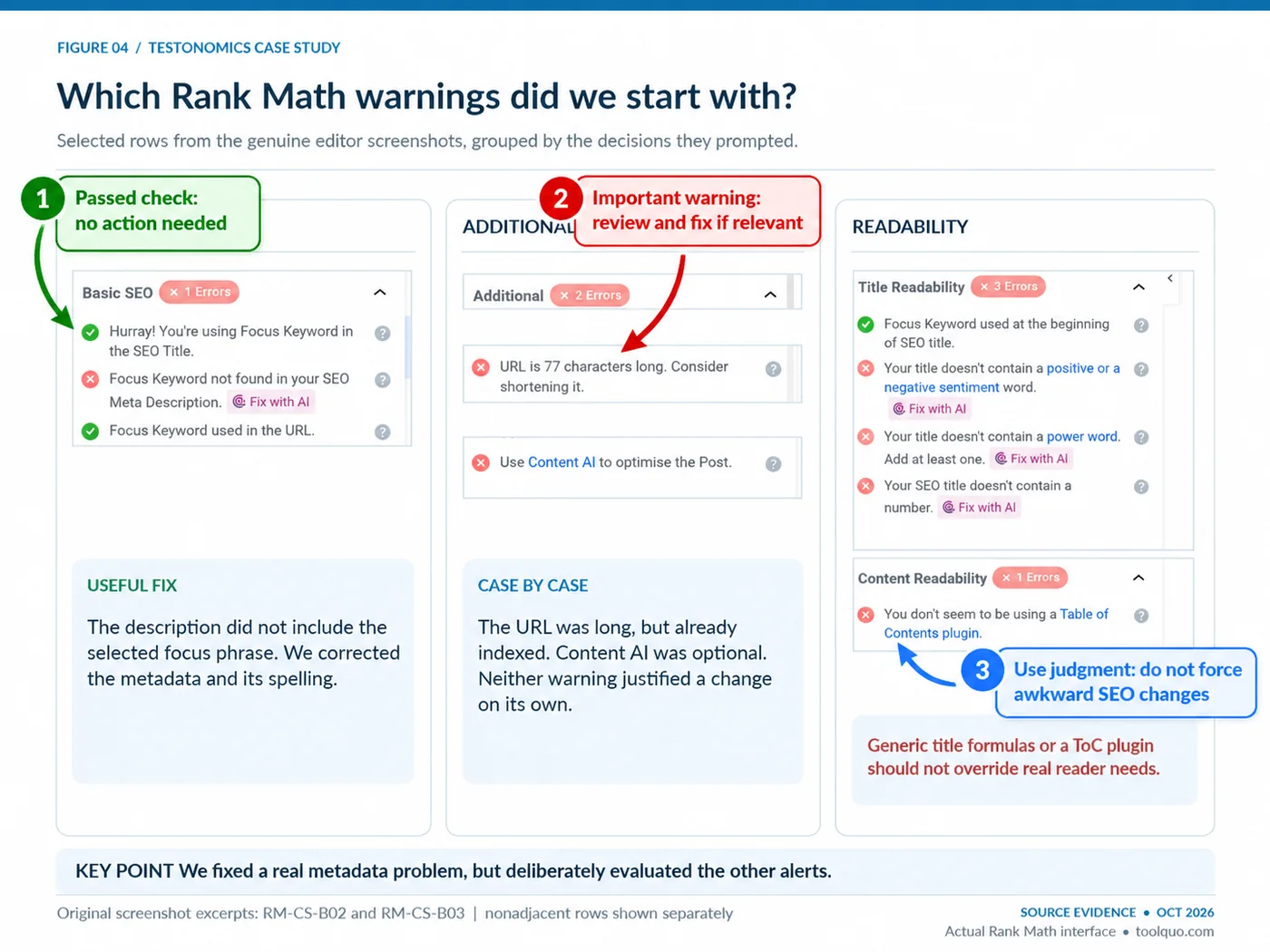
What Rank Math checks: Basic SEO includes several checks involving the main focus keyword, including its appearance in the SEO title, meta description, URL, early content and body text. It can also flag certain content-length conditions. Exact checks and applicable thresholds can vary by plugin version and page setup.
Why these suggestions exist: A descriptive title, relevant address and opening that identifies the subject help readers quickly determine whether they have found the right page. An SEO description provides a short summary that search engines may choose to use as a snippet.
Example: On a guide about Rank Math scores, “Rank Math SEO Score Explained: What Is a Good Score and How to Improve It?” makes the promise clear. A vague title such as “An Important WordPress Feature” does not. Similarly, the address https://toolquo.com/rank-math-seo-score/ communicates the subject more clearly than https://toolquo.com/post-123/
When not to follow blindly: Google can show a different search snippet than your meta description. A title does not have to repeat a focus phrase awkwardly to be useful. And if a published URL is already established, changing it only to shorten it or insert an exact keyword creates redirect and broken-link risks. For an existing page, weigh that risk against the actual benefit.
3.2 Additional SEO: Headings, Keyword Density, Links and Image ALT Text
What Rank Math checks: The Additional SEO group includes checks relating to content organization and other on-page elements. Among its recommendations are focus-keyword placement in subheadings, keyword-related image attributes and link signals. The exact items shown depend on the page and configuration.
Headings example: If a section explains why the score changes after editing keywords, “Why Did My Score Change?” is more informative than “Rank Math SEO Score Information.” Readers use headings to find answers. An exact-match phrase in every H2 would make the page repetitive.
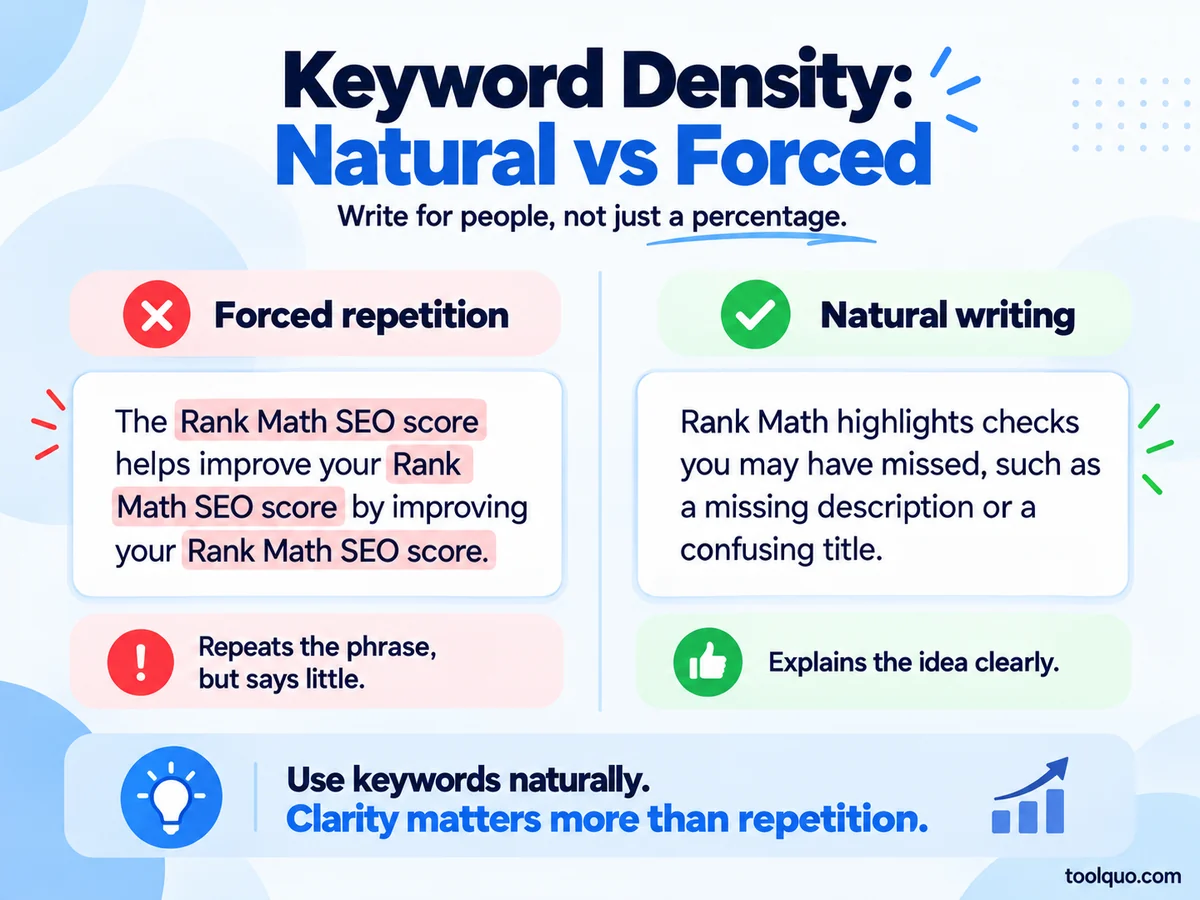
Keyword-density example: Compare “Rank Math SEO score helps you review SEO suggestions. The Rank Math SEO score shows your Rank Math SEO score” with “Rank Math highlights checks you may have missed, such as a missing description or a confusing title.” The second sentence explains the benefit instead of repeating a phrase. A higher keyword count does not rescue weak writing.
Internal-link example: A reader who cannot locate the settings can follow our beginner’s Rank Math tutorial. A reader wondering how the score can change without rewriting content needs our original case study (https://toolquo.com/rank-math-seo-case-study/). These links help people complete a task and can help search engines discover related pages. Random links to unrelated articles would add clutter.
External-link example: A link to Rank Math’s official scoring documentation supports a factual explanation of how its plugin works. Adding a low-quality external link simply to satisfy a checklist adds no comparable value.
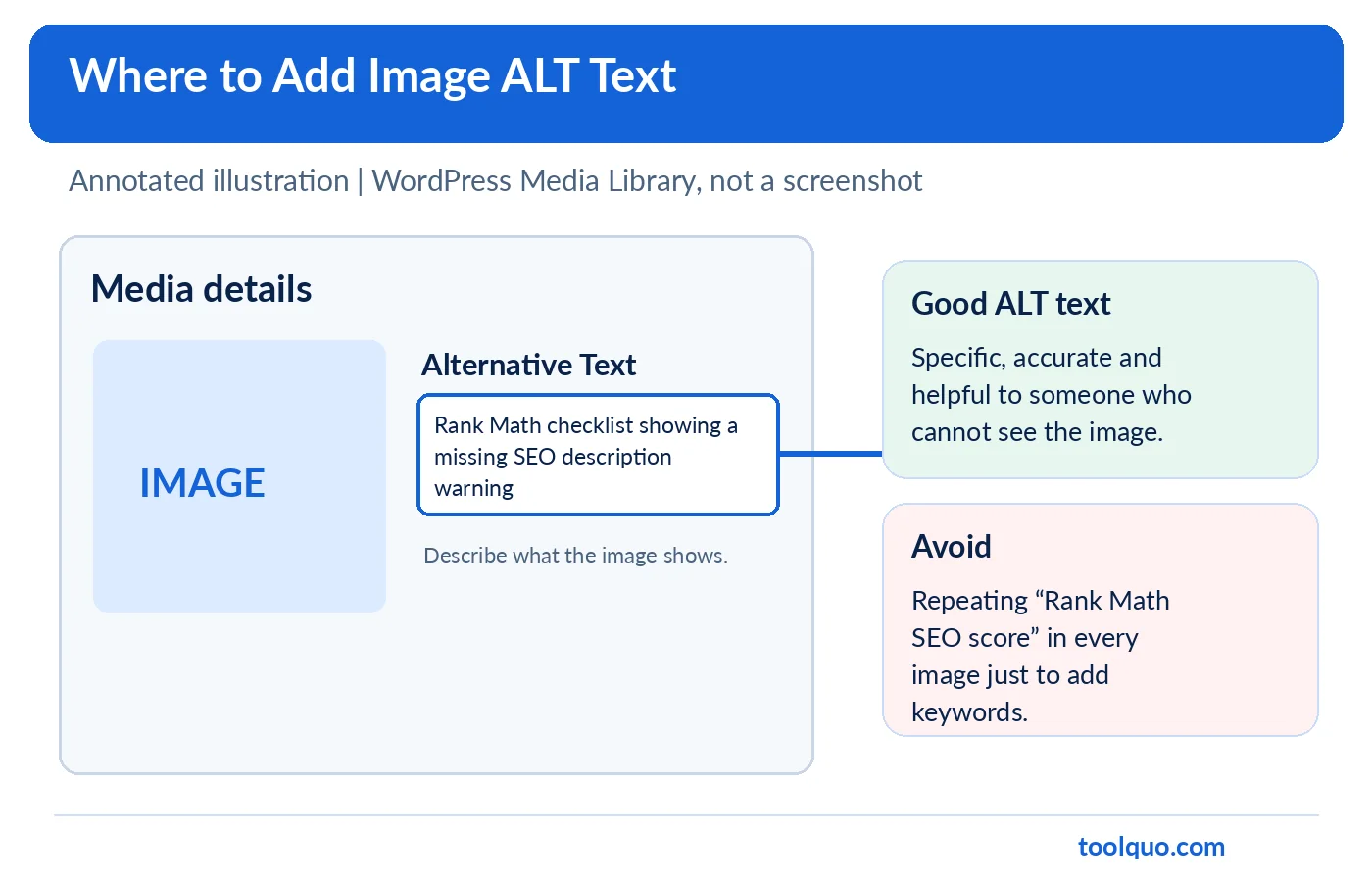
Image ALT text example: For a screenshot showing the SEO panel with a red title warning, appropriate alternative text (ALT text) might be “Rank Math Basic SEO panel displaying a warning about the article title.” It describes what someone unable to see the image needs to know. “Rank Math SEO score Rank Math SEO score WordPress” does not.
When not to follow blindly: Do not stuff keywords into headings, ALT text or paragraphs, and do not add links only to increase the count. Descriptive, natural writing is the goal. We should not target broad terms such as “seo rank math” in this specialized guide merely because keyword tools report searches for them.
3.3 Title Readability: Numbers, Power Words and a Clear Promise
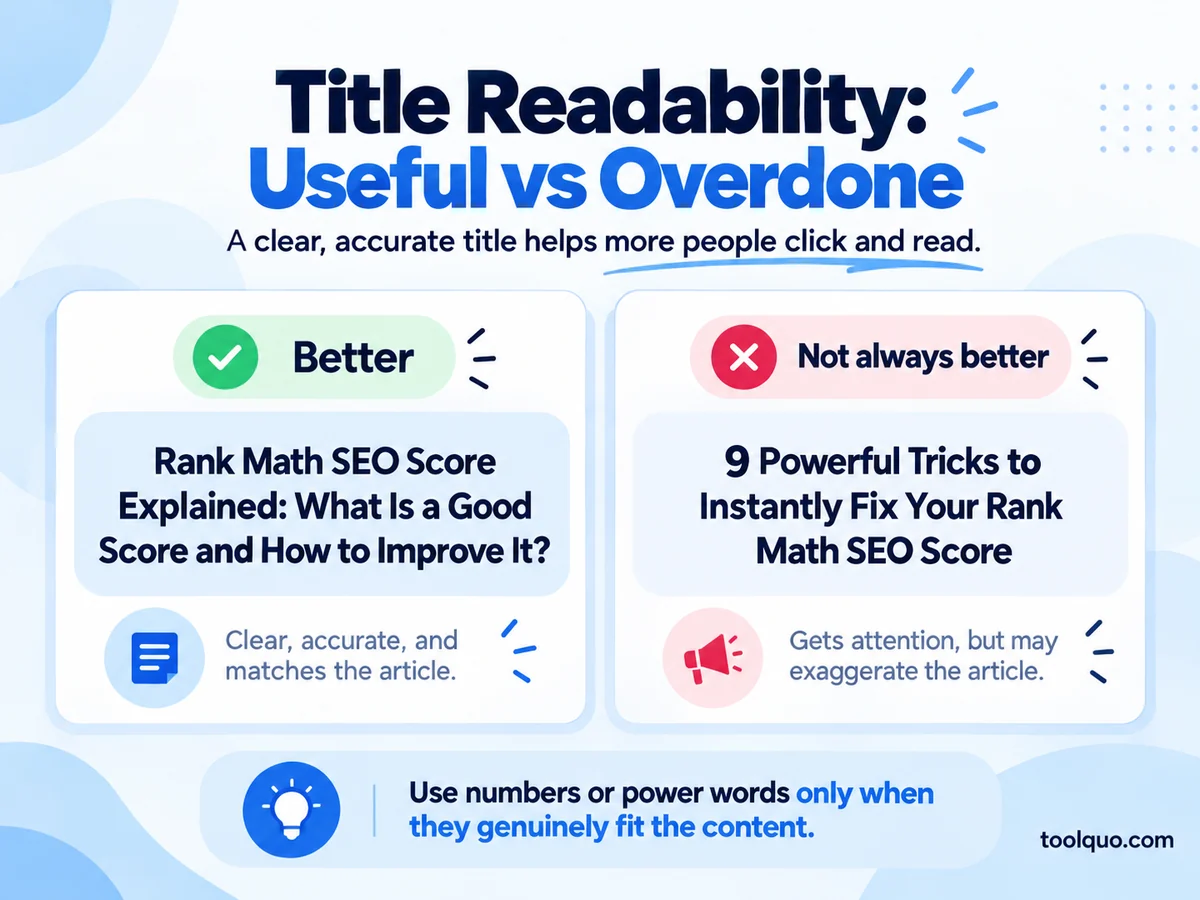
What Rank Math checks: Title Readability offers formula-based headline suggestions. Depending on the headline and settings, these can include attention-grabbing language, positive or negative sentiment, or a number.
Why they exist: A descriptive, appealing headline can make people more willing to choose a relevant result. But the promise must remain truthful.
Example: “7 Ways to Fix a Low Rank Math Score” is appropriate if the post really presents seven actionable methods. It is misleading if the article mainly explains how scoring works and contains no such numbered guide. In that case, our current explanatory title better matches the content, even if a headline-related warning remains.
When not to follow blindly: Never invent a number, exaggerate urgency or use a dramatic “power word” solely for a green tick. An accurate title that attracts the right reader is better than a formula-compliant title that disappoints them.
3.4 Content Readability: Paragraphs, Navigation and Ease of Understanding
What Rank Math checks: Content Readability considers features intended to make a page easier to scan, including aspects of paragraph presentation and navigation such as a table of contents. These checks cannot determine whether your explanation is correct.
Why these suggestions exist: In a long beginner tutorial, brief paragraphs and descriptive sections make the content easier to follow. A functioning table of contents allows someone interested only in score troubleshooting to jump directly there.
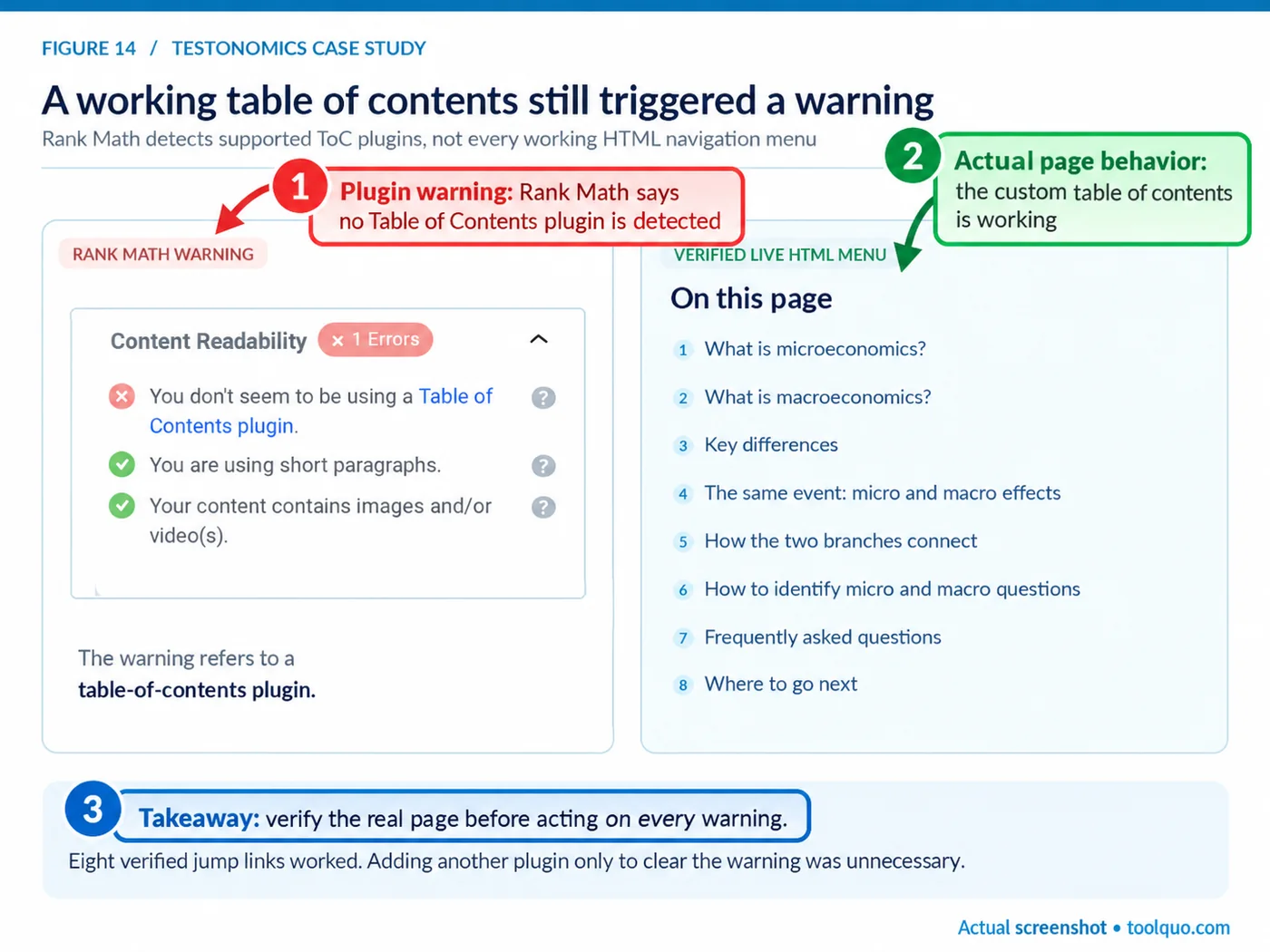
Example: This article is long enough to benefit from a table of contents. A two-paragraph news update might not need one. On Toolquo, Rank Math did not recognize our functioning custom table of contents. The user-facing navigation worked, so installing a duplicate table of contents merely to satisfy the plugin would not necessarily improve anything.
When not to follow blindly: Short sentences and shorter paragraphs are helpful when they improve comprehension, not when they break connected reasoning into fragments. The plugin cannot judge whether a detailed explanation is logically complete or whether an example is misleading.
The essential distinction: Rank Math’s scoring components help flag things worth inspecting. They do not evaluate the intellectual quality, factual accuracy or originality of your article. Those remain editorial responsibilities.
4. How to Improve Your Rank Math SEO Score: A Practical Process
4.1 Start by improving the article, not the number
Before you open the checklist, ask whether the article answers the searcher’s question completely. Is its information accurate and current? Does it explain why things happen, rather than merely listing instructions? Are the examples understandable? Have you left out an important exception? Does the structure let a beginner follow the logic?
A well-written article should survive a simple test: if the Rank Math score were hidden, would you still be confident that the page teaches the reader something valuable? If not, work on the explanation first. Rank Math cannot do that editorial work for you.
4.2 Identify the actual warning
Open the Rank Math analysis and locate the failed check. Translate it into a plain question: Is my SEO description missing? Is this page connected to a relevant guide? Is the primary focus keyword appropriate? Is the plugin merely failing to detect an existing feature?
Do not treat all red marks as equally urgent. A genuinely missing title deserves faster attention than a suggestion to use another power word.
4.3 Correct genuine omissions
Write a clear title and description if either is missing or inaccurate. Improve headings where the structure is confusing. Include informative alt text for meaningful images. Add links to genuinely related pages where readers may need further context.
Make each change because it solves a problem. For instance, a link to our general SEO guide helps readers who do not know what crawling or indexing means; a random link to an unrelated software review does not. A relevant link may make the article easier to use even if the score barely moves.
4.4 Recheck without blindly obeying the remaining items
After saving the page, reopen the analysis to see whether the checklist has updated. If the score rises, inspect which items now pass. If it falls, identify what changed before assuming that the article has worsened.
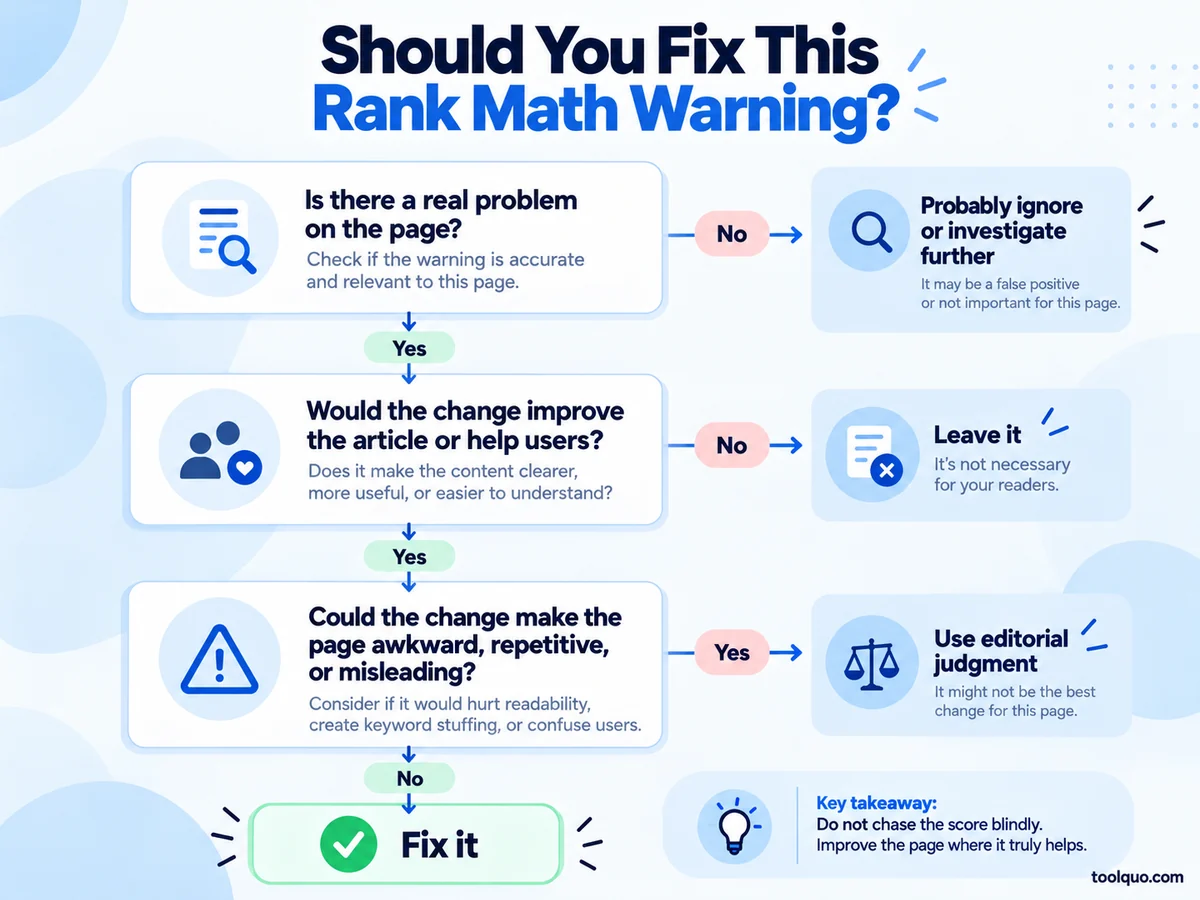
Then decide whether further edits would improve the reader’s experience. If a recommendation would require awkward repetitions, an exaggerated headline, unnecessary links or installing duplicate functionality, leave it unresolved and record your reasoning.
5. Which Rank Math Recommendations Matter Most?
For each warning, distinguish a genuine problem with the actual article or website from a general recommendation that may not fit. For example, an inaccurate description is a real problem because searchers may be misled about the page. A warning to add another power word is only a suggestion about headline style, and may not suit an educational article.
Usually worth fixing: an inaccurate title; a blank or misleading description; genuinely broken links; confusing section structure; missing descriptions for informative images; and relevant content that is difficult to discover through navigation.
Use judgment for keyword density, exact-match phrases in headings, numbers or power words in titles, length of an existing URL, and adding extra links. For example, do not add three unrelated links simply to increase the number of links in a post. Ask whether the proposed change makes the page more useful, not whether it earns another green tick.
Verify before fixing: warnings about a table of contents or other functions implemented through a custom theme or page builder. On Toolquo we found that a functioning custom table of contents was not recognized by Rank Math. The lesson is to inspect the real page before installing another tool or duplicating a working feature.
Content AI can offer additional prompts, but using paid suggestions is not a requirement for producing helpful content.
6. What Our 82 → 81 → 87 Experiment Actually Shows
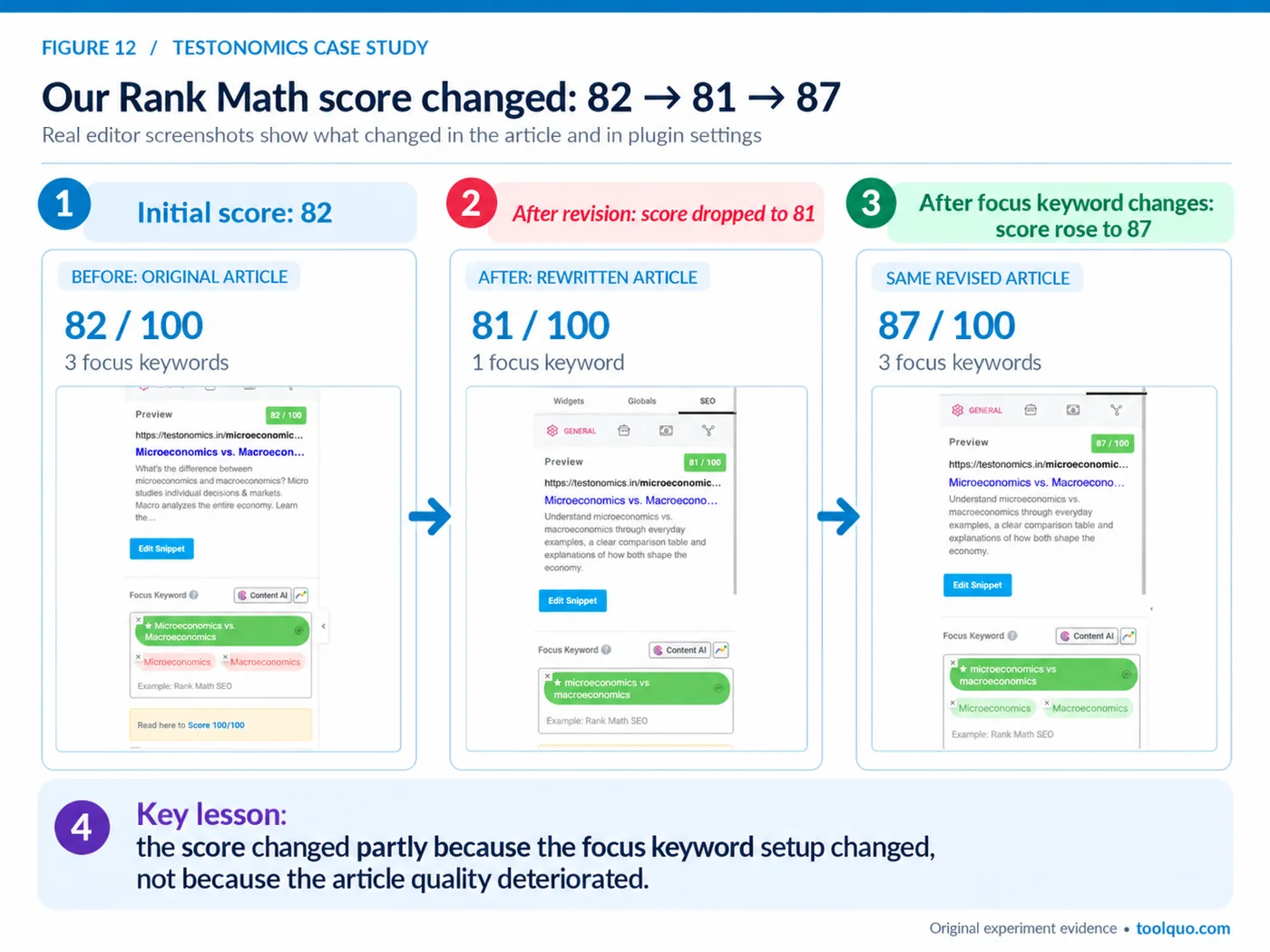
During our Testonomics on-page SEO exercise, an existing economics article was revised. Rank Math displayed 82 before the exercise and 81 after the revision. It would be tempting to interpret that drop as evidence that our work made the article worse. That conclusion would be unjustified.
The scoring configurations were not identical: the original and revised versions had different focus-keyword entries. Rank Math uses those entries when evaluating the page. We therefore cannot isolate the effect of the writing changes from that first comparison.
The next comparison is more revealing. We kept the revised article’s visible text unchanged, changed its focus-keyword configuration, and the score rose from 81 to 87. The plugin recognized additional keyword-related conditions. The article itself had not become clearer or more accurate merely because its keyword fields changed.
This explains precisely why a number can move without a corresponding change in article quality. It does not demonstrate any improvement in rankings or traffic. For the full sequence and original screenshots, read our Rank Math SEO case study: https://toolquo.com/rank-math-seo-case-study/
7. Rank Math’s Sitewide SEO Analyzer Is a Different Score
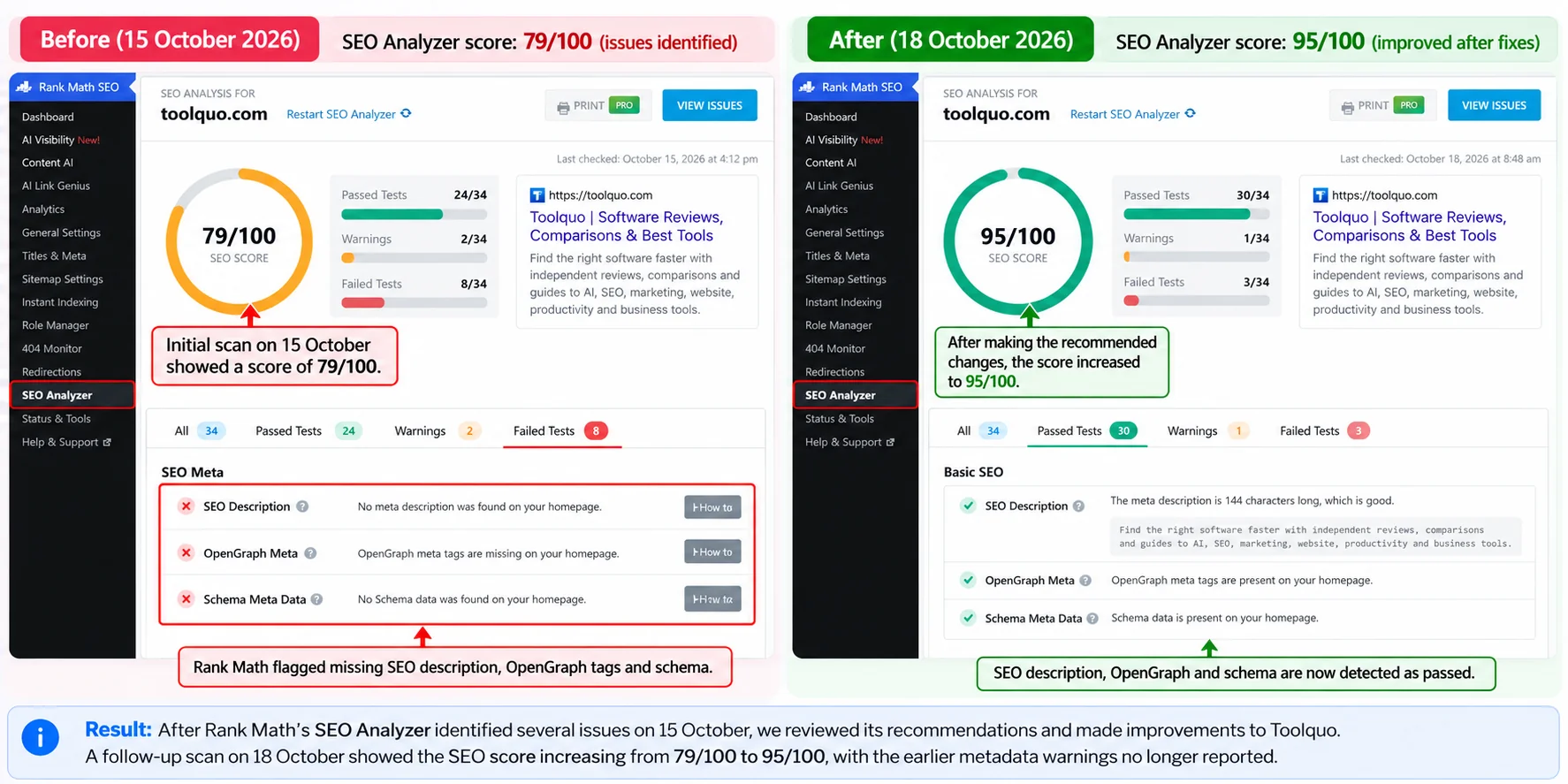
The individual-post RankMath SEO score evaluates selected characteristics of one article or page. Rank Math’s SEO Analyzer reviews a wider range of website-level conditions. These can include SEO configuration, performance and security-related checks. A successful sitewide scan does not mean every article is well written, just as one green-scoring article does not mean the whole website is technically healthy.
On Toolquo, the SEO Analyzer score was 79/100 on October 15, 2026, with 24 checks passed and eight failed. On October 18, it was 95/100, with 30 passed and three failed. More of the analyzer’s checks passed in the later scan. That is the supported conclusion.
It would be wrong to say the difference automatically represents a 16-point improvement in overall website quality or predicts additional organic traffic. We also encountered a performance-related analyzer result that required separate verification rather than being accepted as definitive evidence of a real mobile speed issue.
When looking at sitewide warnings, prioritize conditions that could affect access, indexing, important navigation or security. Verify problems independently before making changes. More details appear in our hands-on Rank Math review: https://toolquo.com/rank-math-review/
8. Why Is Your Rank Math Score Low, Missing or Not Updating?
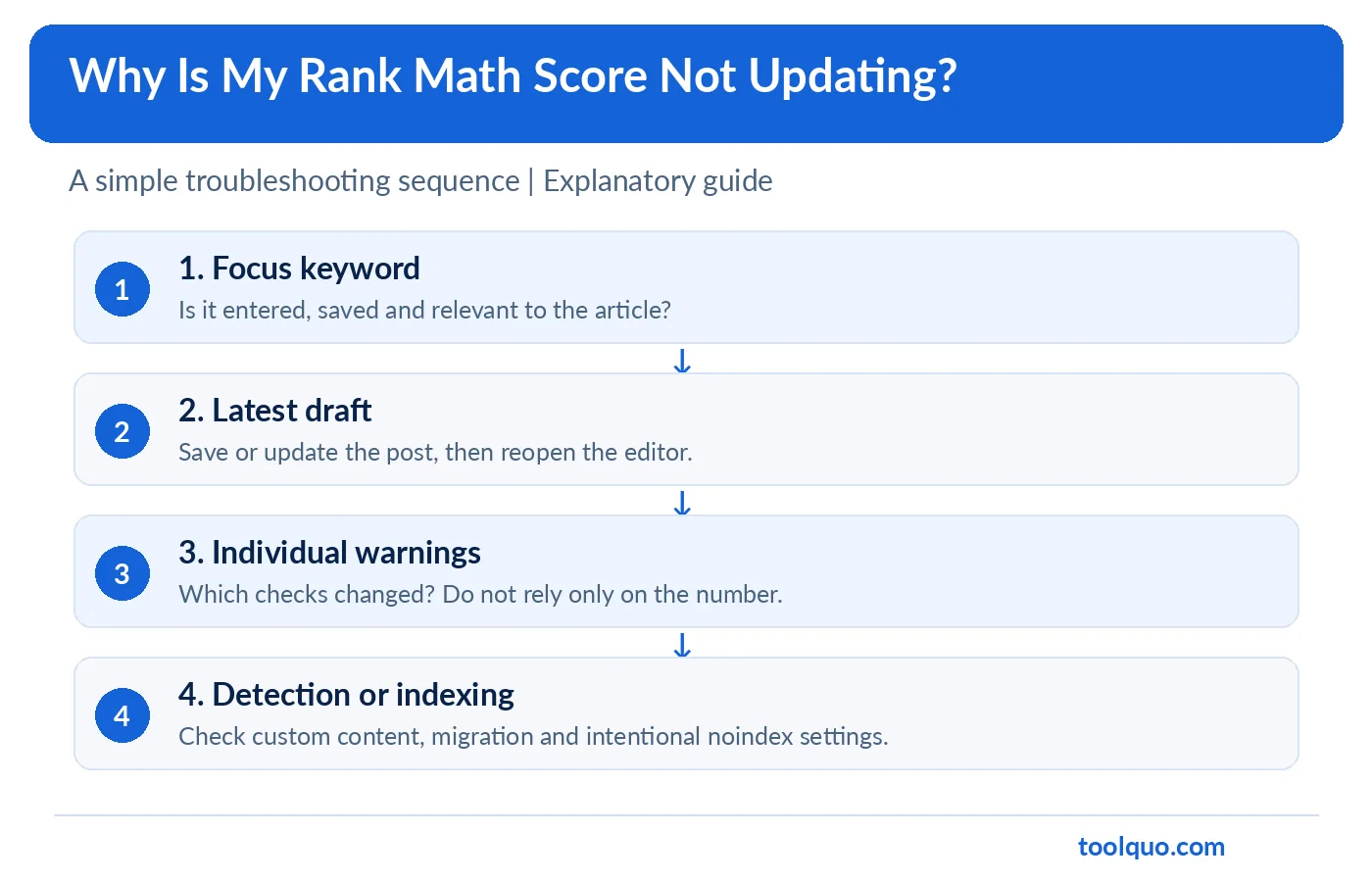
Start with the symptom below, then use the detailed explanations in this section. A warning is a reason to investigate, not proof that the page needs rewriting.
| Symptom | Possible cause | First action |
|---|---|---|
| Low score despite useful content | The focus keyword does not represent the page, or individual checklist items remain unmet. | Check the keyword and read each warning. Correct meaningful omissions rather than repeat keywords mechanically. |
| N/A instead of a number | The post may not have been analysed, a focus keyword may be missing, or indexing settings may affect scoring. | Check the keyword and intended indexing settings. Keep deliberately noindexed pages noindexed. |
| Working table of contents flagged as missing | The analysis may not recognise a custom implementation. | Test the published navigation. Our case study documents this mismatch; avoid adding a duplicate solely for the score. |
| Score appears unchanged after editing | The editor may show an older analysis. | Save, reopen the editor and compare individual recommendations. If it persists, consult troubleshooting guidance before making broader changes. |
8.1 The focus keyword does not match the page
If your chosen focus keyword describes a different search intent, the plugin will assess your article against the wrong phrase. For example, “rank math seo plugin” commonly suggests a general plugin topic, while this page is specifically about interpreting scores. Choosing the broader keyword just because it has higher estimated search volume would make the analysis less useful. Use the phrase that honestly represents the article.
8.2 The plugin has not calculated a score
A score displayed as N/A is different from a low numeric score. Rank Math notes that this may occur when an imported post has not been analyzed, a focus keyword is absent, or the page is intentionally set to noindex. Check the page’s settings first, and use official recalculation guidance only if relevant. Do not change an intentionally noindexed page into an indexable one merely to earn a score.
8.3 Rank Math does not recognize existing content or a custom feature
If it flags a missing table of contents despite a working custom one, verify what readers actually see. Similar discrepancies can arise when editor content or custom implementations are not recognized as expected. Investigate compatibility if necessary; do not assume the feature is absent.
8.4 The editor shows an older analysis
Save or update the page, then refresh or reopen the editor and check again. If a discrepancy remains, review Rank Math’s troubleshooting documentation before changing plugin installations or running broad database operations. Also compare the actual recommendations, not just the overall number.
Official reference: https://rankmath.com/kb/seo-analysis/
9. How to Measure Real Search Performance Separately
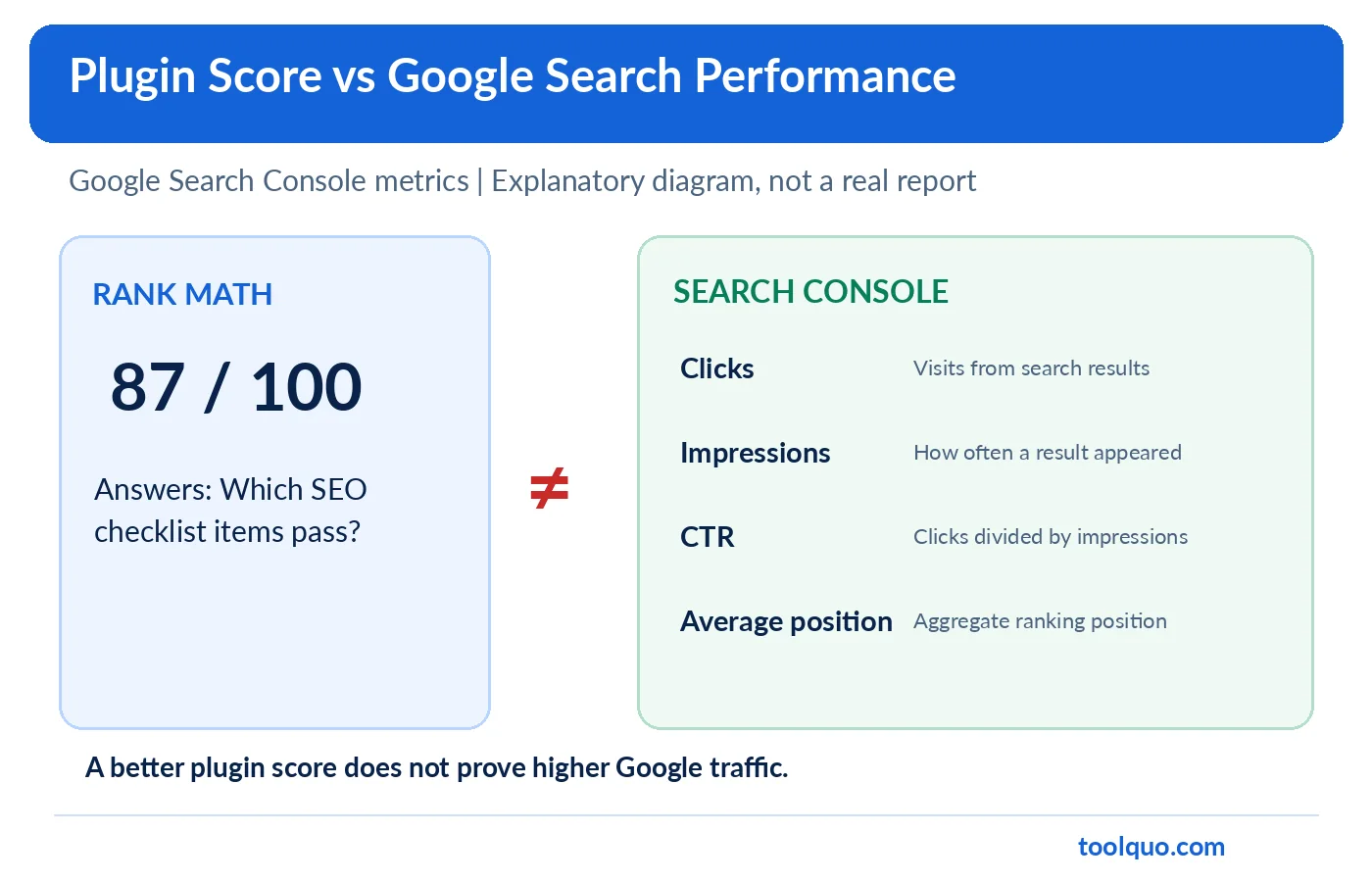
A Rank Math score measures compliance with a checklist. Google Search Console reports how your pages perform in Google Search. Those are different kinds of information and should not be combined into one “SEO success” number.
To examine an article, open the correct Search Console property, select Performance → Search results and apply a page filter for its URL. Review the queries for which the page appeared, impressions, clicks, click-through rate and average position.
Impressions indicate how often the page appeared in qualifying search results; clicks count visits from those results under Search Console’s reporting rules. CTR is clicks divided by impressions. Average position is an aggregate over the recorded searches and should not be interpreted as a fixed rank that every user sees.
Compare reasonably similar time periods and allow time for search engines to discover updates. A change in clicks can be caused by multiple factors, including search demand, competition, changing results pages and the content itself. If your score moves from 81 to 87, that alone tells you nothing conclusive about Google traffic.
Google reference: https://support.google.com/webmasters/answer/7576553
10. A Sensible Pre-Publication Checklist
□ The article answers the reader’s main question near the beginning.
□ The facts are accurate, examples are understandable, and important caveats are included.
□ The focus keyword genuinely represents the article’s subject.
□ The title and description accurately describe the page.
□ Headings and navigation make the explanation easy to follow.
□ Images are helpful, with appropriate alternative text.
□ Internal links lead to genuinely relevant pages.
□ Important SEO or technical warnings have been checked and resolved where appropriate.
□ Any ignored warning has a clear editorial reason.
□ The intended indexing setting is correct, and the page works properly on mobile.
□ Future performance will be judged using real search data, not only the Rank Math score.
If you remember just one idea: produce the best article for the intended reader, then use Rank Math as a supporting checklist. Never reverse those priorities.
11. Frequently Asked Questions About the Rank Math SEO Score
11.1 Is 80 a good Rank Math SEO score?
It is the top of Rank Math’s yellow band. Review the remaining recommendations and fix meaningful omissions, but do not assume that an 80-scoring article is poor quality.
11.2 Is 90 better than 80?
It means the page performed better against the plugin’s scoring checks. That may reflect useful changes, but it does not establish that the explanation is better or that Google will rank it higher.
11.3 Should every article score 100?
No. A perfect checklist score is optional. Accuracy, clarity, usefulness and appropriate technical setup matter more than squeezing out the last points.
11.4 Can a page with a low score rank?
Yes. Google does not use Rank Math’s displayed number as a ranking factor. A low score is a reason to review the page, not proof that it cannot perform.
11.5 Why did my score fall after I improved the writing?
An edit may affect one of Rank Math’s checks, or the focus-keyword configuration may have changed. Inspect the individual recommendations to see what actually happened. A falling score does not establish that the revised writing is less helpful.
11.6 Why does Rank Math show N/A?
The score may not yet have been calculated, the focus keyword may be missing, or the page may have settings such as noindex that affect scoring. Confirm the reason before attempting a fix.
11.7 Is the sitewide SEO Analyzer score the same as a post score?
No. The SEO Analyzer checks selected website-level conditions, while a post score reviews an individual page’s content and settings.
Conclusion: Better Articles First, Better Scores Second
Rank Math is useful precisely because it can remind you of easy-to-miss issues while you work. But it cannot judge whether your argument is correct, whether your explanations are sufficiently detailed or whether your examples genuinely help a beginner. Those decisions require research, editing and reader-focused judgment.
Use the checklist, understand why a recommendation exists, and make the change when it improves the page. Ignore it when following it would add clutter or weaken your writing. Aim to create a high-quality article, not a high-scoring article at any cost.
How to use Rank Math: https://toolquo.com/how-to-use-rank-math-seo/
Rank Math review: https://toolquo.com/rank-math-review/
Original SEO score case study: https://toolquo.com/rank-math-seo-case-study/
What is SEO?: https://toolquo.com/what-is-seo/
About the author
Nikhil Bhardwaj
Founder & Editor, Toolquo
Nikhil leads Toolquo’s editorial direction, focusing on practical software research, transparent comparisons, and clear buying decisions.
View author profile →Keep exploring
Related guides
November 2, 2026
Yoast SEO Score Explained (2027): What Do Green, Orange and Red Lights Mean?
Understand Yoast SEO’s traffic lights, see our original test, and learn which SEO and readability recommendations…